
Mastering Information Retrieval System Design for RAG
Explore our expert guide on information retrieval system design for RAG. Learn to optimize chunking, indexing, and retrieval for high-performance AI.
At its core, designing an information retrieval (IR) system for Retrieval-Augmented Generation (RAG) is about building a highly specialized librarian for your AI. A great system doesn't just find any information; it finds the right information—the kind that turns a generic LLM response into something genuinely sharp and insightful. Getting this blueprint right is the key to stamping out hallucinations and irrelevant answers for good.
The Blueprint for a High-Performing RAG System
A truly effective RAG pipeline is so much more than a vector database plugged into an LLM. Think of it as a finely tuned assembly line for knowledge. Raw, unstructured documents go in one end, and out the other come perfectly formed, context-rich information packets ready to feed your AI. This is where effective AI powered knowledge management comes into play, helping you extract real value from scattered data sources.
The entire lifecycle breaks down into five critical stages. Each step is an opportunity to improve the final output, building on the last to prepare your data for high-quality retrieval.
The Five Stages of a RAG-Optimized Pipeline
Let's walk through the journey from raw document to LLM-ready context, focusing on actionable steps.
- Ingest: This is the starting line. Here, you're just pulling in the raw documents from all over the place—think PDFs, Markdown files, web pages, you name it. The key action here is to normalize content, such as converting HTML to clean text.
- Chunking: Next, those large documents get broken down into smaller, more manageable pieces, or "chunks." How you do this is absolutely critical for keeping the original meaning intact and ensuring retrieval accuracy.
- Indexing: Each chunk is then transformed into a numerical representation (we call this an embedding) and stored in a searchable index, typically a vector database. Metadata like source and date should be attached here.
- Retrieval: When a user finally asks a question, the system springs into action, searching the index to pull out the most relevant chunks of information. This is where hybrid search strategies shine.
- Ranking: Finally, the system sorts the retrieved chunks by relevance, making sure the LLM gets the absolute best context at the very top of the list. Re-ranking models can significantly boost performance at this stage.
This whole process—from raw data to a query-ready index—is the foundation of your RAG system.
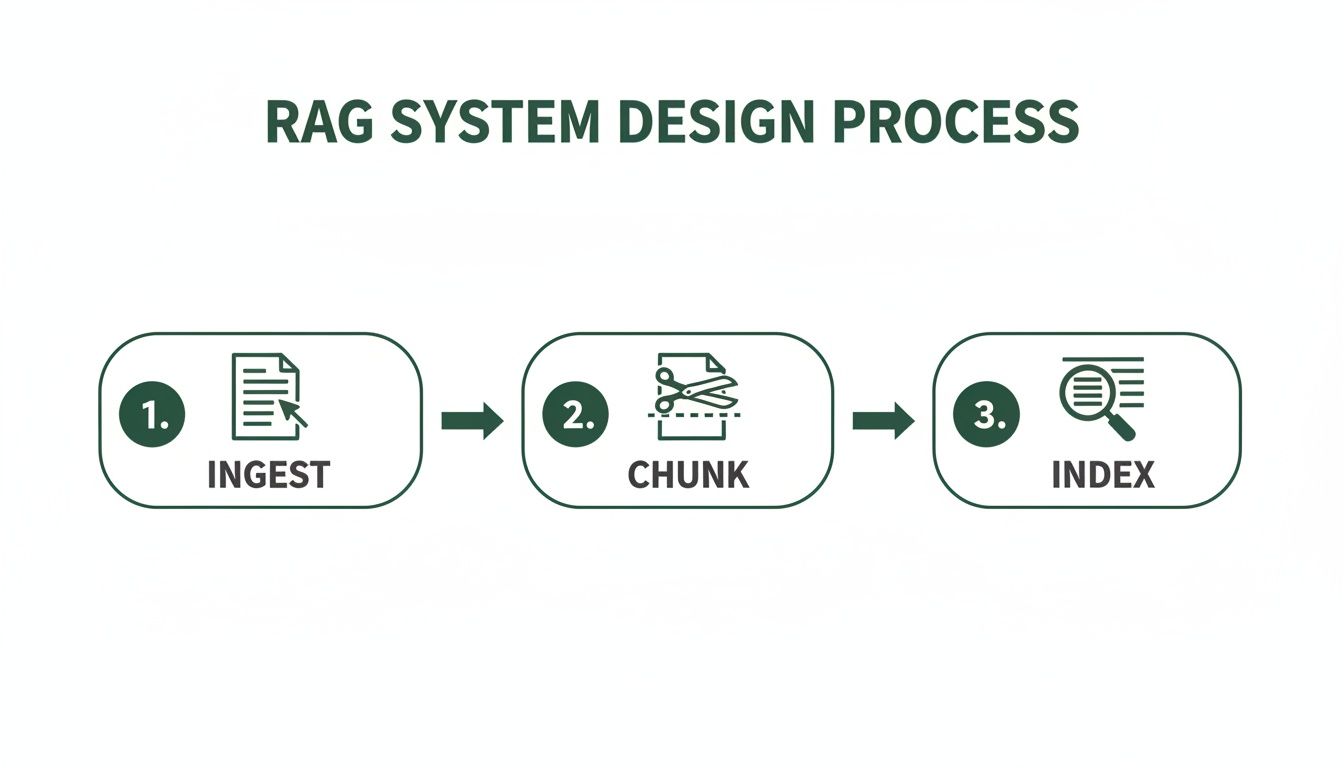
The diagram above shows how this flow works. Raw data is methodically processed, turning messy documents into a structured, searchable knowledge base. It's important to remember that each stage has to be tuned carefully. A mistake early on, like a poor chunking strategy, will snowball and hurt the performance of the entire system down the line.
Key Takeaway: The quality of your retrieval system is only as strong as its weakest link. A common mistake is to focus only on the fancy retrieval algorithm while neglecting foundational steps like chunking. This almost always leads to poor RAG performance.
This table summarizes how each component contributes to enabling better retrieval.
Key Stages of a RAG-Optimized IR System
| Component | Primary Goal in RAG | Actionable Insight for Better Retrieval |
|---|---|---|
| Ingest | Collect and normalize diverse data sources. | Implement robust parsers for different file types (PDF, HTML) to extract clean text and metadata. |
| Chunking | Break documents into semantically meaningful units. | Use semantic or heading-based chunking instead of fixed-size splits to preserve context. |
| Indexing | Create a fast, searchable representation of the chunks. | Attach rich metadata (source, date, section) to each chunk to enable powerful pre-search filtering. |
| Retrieval | Find the most relevant chunks for a given user query. | Implement a hybrid search strategy (combining keyword and vector search) to handle diverse queries. |
| Ranking | Order retrieved chunks by importance and relevance. | Use a lightweight cross-encoder model to re-rank the top K results for maximum precision. |
Understanding these stages provides a solid foundation. If you want to see how these pieces fit together in a real-world build, you can dive deeper into the complete RAG pipeline. In the sections that follow, we'll break down each of these components in much more detail, giving you practical tips for designing and optimizing your own information retrieval system.
How to Master Context-Aware Document Chunking
The quality of your retrieval directly reflects your chunking strategy. Think about it: if you fed an AI random, fragmented sentences from a book, it would never grasp the plot. It's the same with your documents. Poorly divided text creates broken context, leading to irrelevant search results and confused LLMs.
This is why mastering chunking is a non-negotiable, high-leverage action for building a high-performance RAG system.
Simply splitting documents at a fixed size just won’t cut it for serious RAG applications. To improve retrieval, you must use smarter, context-aware methods that respect the natural boundaries of the information itself.
The core challenge here isn't new. The foundations were laid back in the 1960s and 1970s through massive experiments that still influence our modern tools. Cyril Cleverdon's landmark Cranfield tests gave us the precision-recall framework—a way to measure how well a system retrieves relevant documents without pulling in a bunch of noise. That's the exact same trade-off we wrestle with when evaluating chunk quality today.
Choosing Your Chunking Strategy
There's no silver bullet here. The best strategy always depends on your documents. A technical manual full of nested sections is a completely different beast than a free-flowing legal contract. The ultimate goal is to create chunks that are self-contained, meaningful units of information.
Here are three actionable strategies to improve your RAG retrieval:
- Paragraph-Based Chunking: This is a great starting point. You split documents along paragraph breaks, which naturally group related ideas. It’s a huge step up from arbitrary character counts because it preserves local context.
- Heading-Based Chunking: For structured content like reports or official documentation, this approach is incredibly effective. It uses headings (H1, H2, H3) to create a hierarchy, ensuring a piece of text stays connected to its guiding title. This provides a much richer contextual signal during retrieval.
- Semantic Chunking: This is the more advanced play. Instead of looking at formatting, it uses embedding models to figure out where topics shift. It splits the document based on conceptual similarity, creating chunks that are thematically cohesive from start to finish. If you want to go deeper, our guide on understanding semantic chunking is a great resource.
Fine-Tuning Chunk Size and Overlap
Once you’ve picked a strategy, the real work begins: tuning the parameters. Chunk size and overlap are the two main levers you can pull to dial in performance.
Key Insight: The perfect chunk is a balancing act. It must be small enough to be a specific, focused match for a query, yet large enough to contain enough context for the LLM to generate a useful answer.
Chunk size directly impacts this balance. A chunk of 512 tokens might work beautifully for dense, prose-heavy content. But for a sprawling technical guide, a larger 1024-token chunk might be needed to capture the full context of a section.
Overlap is just as critical. Chunk overlap means including a small piece of the previous chunk at the start of the next one. This simple trick creates a contextual bridge between adjacent chunks, making sure you don't lose crucial information right at the split. A typical overlap is around 10-20% of the chunk size.
Visualizing and Validating Your Chunks
So, how do you know if your strategy is actually working? You have to look at the output.
A visual tool that maps each generated chunk back to the source document is invaluable. It lets you instantly spot and fix bad splits where context gets broken.
For instance, you might see a table awkwardly sliced across two chunks or a critical conclusion severed from its introductory paragraph. By visualizing these problems, you can iterate. Tweak your chunk size, increase the overlap, or even switch strategies entirely until every single chunk is a clean, coherent, and retrieval-ready asset for your AI. This hands-on validation is what separates a decent retrieval system from a truly great one.
Choosing Your Indexing and Retrieval Strategy
Once your data is perfectly chunked, the next step in building a top-tier information retrieval system is making those chunks discoverable. Think of it like organizing a massive library; you need a brilliant librarian who understands not just keywords, but the ideas behind the words. This is the world of indexing and retrieval—the process that turns static text into a dynamic, searchable knowledge base.
How we do this has come a long way. The core ideas actually trace back to the mid-20th century, a time that laid the foundation for modern search. In the 1950s, a pioneer named Calvin Mooers coined the term 'information retrieval', sparking innovations like KWIC indexes that analyzed every word in a text. This work directly led to Gerard Salton's SMART system in the 1960s, which introduced the vector space model. It was a groundbreaking idea: represent documents and queries as vectors and measure their similarity. This is the bedrock concept behind today's powerful embedding-based retrieval.
Sparse vs. Dense Retrieval: A Modern Showdown
At the heart of any modern retrieval strategy is a choice between two main methods: sparse and dense retrieval. Each has distinct strengths, and picking the right one (or combination) is critical for an effective RAG system.
Sparse retrieval is your classic, keyword-based search. It relies on algorithms like BM25 to build an index based on word frequency. It's a sharpshooter, excelling at matching exact terms, acronyms, or specific product codes. If a user searches for "Project Titan-X," sparse retrieval will zero in on documents containing that exact phrase with high precision.
Dense retrieval, on the other hand, is all about semantic or conceptual search. It uses deep learning models—what we call embedding models—to convert your text chunks into numerical vectors, or embeddings. These vectors capture the meaning of the text, not just its keywords. This is what allows it to find documents that are conceptually similar, even if they don't share any of the same words. A search for "workplace safety regulations" might match a chunk about an "employee conduct policy" because the system understands the ideas are related.
Key Takeaway: Don't think of it as sparse versus dense. The most actionable strategy is to combine them. One finds the needle in the haystack with perfect precision, while the other understands the entire context of the haystack itself.
The best strategy for most RAG applications is to blend the two approaches. This "best of both worlds" method is called hybrid search. Let's break down how these three methods compare.
Comparing Sparse vs. Dense vs. Hybrid Retrieval
| Retrieval Method | How It Works | Best For | Actionable Tip for RAG |
|---|---|---|---|
| Sparse Retrieval | Matches exact keywords using algorithms like BM25. It scores documents based on term frequency and rarity. | Finding specific names, acronyms, SKUs, or jargon. Excellent for precision on known-item searches. | Ensure your text extraction process preserves important codes and identifiers for BM25 to index. |
| Dense Retrieval | Converts text and queries into vectors (embeddings) and finds chunks with the closest meaning in vector space. | Discovering conceptually related information, answering broad questions, and handling synonyms or paraphrasing. | Choose an embedding model fine-tuned for your domain (e.g., finance, legal) for better relevance. |
| Hybrid Retrieval | Combines the scores from both sparse and dense methods, re-ranking results to get the best of both. | Almost all production RAG systems. It balances keyword precision with semantic understanding. | Start with a 50/50 weighting for sparse and dense scores, then tune the balance based on evaluation metrics. |
By combining the precision of sparse with the conceptual reach of dense, a hybrid approach ensures your system can handle the widest possible variety of user queries. A user searching for "safety protocols for the XR-42 device" gets both the specific device match and related documents about general equipment handling.
Designing a Robust Retrieval System
Building an effective retrieval system is more than just plugging in a vector database. It's about thoughtful design choices.
- Select the Right Embedding Model: Not all models are created equal. Some are trained on general web text, while others are fine-tuned for specific domains like finance or medicine. Always choose a model that aligns with your data and the kinds of questions you expect users to ask.
- Enrich with Metadata: Attach metadata to each chunk—the document source, creation date, author, or section title. These tags act as powerful pre-filters, letting you narrow the search space before the vector search even begins. For instance, you can limit a search to only documents from the legal department created in the last quarter.
- Optimize Your Vector Database: The vector database is the engine of dense retrieval, built for one thing: blazing-fast similarity search across millions or even billions of vectors. Platforms like Elasticsearch also offer robust indexing capabilities essential for scaling. You can dive into the practical steps with our guide on how to create an index in Elasticsearch.
By combining these strategies—choosing the right retrieval method, enriching data with metadata, and using a specialized database—you transform a simple search tool into a sophisticated knowledge engine. This is the foundation that fuels high-quality, context-aware AI responses.
Building a Production-Ready RAG Pipeline
Moving a Retrieval-Augmented Generation (RAG) prototype out of the lab and into a production environment is a serious engineering challenge. It's the difference between a cool proof-of-concept and a reliable, scalable system that real users can depend on. This jump requires solving tough problems around performance, reliability, and maintenance.
A production-grade pipeline has to be solid from start to finish. It all begins with an ingestion process that can handle a steady stream of new or updated documents without breaking a sweat. From there, the data flows through chunking and embedding before landing in an index built for speed and uptime. This is where theory hits the road.

Balancing Latency and Accuracy
One of the eternal struggles in production is the trade-off between speed (latency) and quality (accuracy). Let's be honest: a system that takes 30 seconds to give a perfect answer is basically useless. Most users would much rather have a 95% correct answer in under two seconds. Their expectations define your success.
Striking this balance comes down to smart architectural decisions.
- Optimized Retrieval Models: Sure, complex strategies like hybrid search followed by a re-ranking model give you better accuracy. But every additional step adds precious milliseconds. You need to profile each component to find and crush bottlenecks.
- Efficient Indexing: How you configure your vector database is a huge deal. Using optimized indexes like HNSW and provisioning the right hardware is non-negotiable for keeping queries fast as your data grows.
- Caching Layers: This is a classic for a reason. Caching common queries can slash your response times. If ten people ask the same thing, the last nine should get a near-instant answer from the cache.
Implementing Robust Monitoring and Logging
You can't fix what you can't see. Once your RAG pipeline is live, comprehensive monitoring isn't a "nice-to-have"—it's an absolute necessity. Flying blind means you can't diagnose problems, prove that your changes are improvements, or even know when things are going wrong.
A production RAG system without detailed logging is a black box. When a user gets a poor response, you need a clear data trail to understand exactly what went wrong—which chunks were retrieved, how they were ranked, and what context was passed to the LLM.
Your monitoring setup should keep a close eye on a few key areas:
- System Health Metrics: Cover the basics like CPU and memory usage, query latency, and error rates for every service in your pipeline.
- Retrieval Quality Metrics: Track core IR metrics like hit rate and Mean Reciprocal Rank (MRR). A sudden drop is a major red flag that something is off with new data or a recent model update.
- User Feedback Loops: Build simple "thumbs up/down" buttons into your application. This raw, qualitative feedback is pure gold for spotting failure patterns that your automated metrics will completely miss.
Managing Data Governance and Security
In any real business, not all data is for all eyes. A production-ready RAG system has to be built with data governance and security from day one. This isn't an afterthought; it’s a core piece of responsible information retrieval system design.
The best place to start is with Role-Based Access Control (RBAC) baked directly into your retrieval logic. When a query arrives, the very first step should be checking the user's permissions. Those permissions then act as a hard filter on the search, ensuring that only documents the user is allowed to see are ever considered for retrieval. This stops sensitive info from ever getting close to the LLM in the first place.
To keep the entire system running smoothly, integrating robust AI operations software is a critical step for monitoring, maintenance, and overall operational health.
So, you’ve built a retrieval system. How do you actually prove it’s working well? A gut feeling isn't a metric, and without hard data, you're just flying blind. A solid evaluation framework is what separates a high-performing system from one that just can't seem to find the right information. It’s the only real way to know if your tweaks are actually making things better.
<iframe width="100%" style="aspect-ratio: 16 / 9;" src="https://www.youtube.com/embed/NDWdkmvX91E" frameborder="0" allow="autoplay; encrypted-media" allowfullscreen></iframe>This data-driven approach is all about creating a continuous improvement cycle. You can test a new chunking strategy, swap out an embedding model, or adjust your retrieval algorithms and measure the exact impact. This idea isn't new, either; it has deep roots in the history of information retrieval.
Back in the 1990s, for instance, the field took a massive leap forward thanks to initiatives like the Text REtrieval Conference (TREC). Launched in 1992, TREC gave researchers huge collections of millions of documents, creating a standardized playground to test and scale up evaluation methods. Fast forward to the 2020s, and we’re seeing an explosion of innovation with models like ColBERT and benchmarks like BEIR that are pushing the limits of zero-shot performance. If you're curious, you can explore a detailed history of these milestones to see how we got here.
Key Metrics for RAG Retrieval
To start measuring, you need the right tools for the job. For RAG systems, the main thing we care about is whether the correct context was retrieved—not just any old context. Here are the three essential metrics you should be tracking:
-
Hit Rate: This is the simplest one. It just asks: "Did the retriever find the correct document chunk at all?" If the ground-truth answer is somewhere in your top k retrieved chunks (say, the top 5), it’s a "hit." A high hit rate is the bare minimum for a system that works.
-
Mean Reciprocal Rank (MRR): MRR is a bit smarter. It doesn't just check for a hit; it rewards the system for ranking the correct chunk higher up the list. If the right chunk is result #1, it gets a perfect score of 1. If it's #2, it gets 0.5; if it's #3, it gets 0.33, and so on. MRR is a big deal for efficiency because you want the best context to show up first.
-
Normalized Discounted Cumulative Gain (NDCG): This is the most sophisticated of the three. NDCG is perfect for when multiple chunks could be relevant, but some are clearly more valuable than others. It rewards your system for ranking highly relevant chunks above moderately relevant ones, giving you a much more nuanced picture of performance.
Key Insight: Start with Hit Rate to make sure you're finding the right information. Move on to MRR to optimize your ranking. Use NDCG when you need to handle different levels of relevance in your results.
Establishing a Continuous Improvement Cycle
With these metrics in your toolkit, you can build a feedback loop to systematically improve your system. This is the process that drives real-world gains.
-
Create a Golden Dataset: First, build a test set of question-and-answer pairs based on your own documents. This "golden dataset" is your ground truth, the benchmark you'll measure everything against.
-
Establish a Baseline: Run your current retrieval system against this dataset and record your baseline scores for Hit Rate, MRR, and NDCG. This is your starting point.
-
Isolate and Test Changes: Now, the fun part. Make one change at a time. Maybe you experiment with a different chunking strategy, switch to a new embedding model, or tweak the weights in your hybrid search.
-
Measure and Compare: Rerun the evaluation on your golden dataset and see what happened. Did MRR go up? Did Hit Rate drop? The data will give you a clear yes or no answer.
-
Iterate and Deploy: If the change was a success, push it to production. If not, scrap it and move on to your next hypothesis. This iterative, data-backed approach is the secret to building a truly exceptional retrieval system.
Common Questions About RAG Information Retrieval
When you start building a serious information retrieval system for RAG, the same questions tend to pop up again and again. Getting these right from the start can save you a mountain of headaches and rework later on.
Let's cut through the noise and tackle the practical questions that trip up even experienced developers.
What Is the Biggest Mistake in RAG System Design?
The single biggest mistake is a classic case of misplaced focus. Teams get obsessed with the shiny objects—the LLM and the vector database—while completely glossing over the unglamorous but critical work of data preparation. They often just throw a default, fixed-size splitter at their documents and call it a day.
This is where things go wrong. Poor chunking and a lack of metadata enrichment are the root causes of most bad RAG outputs. If the context you feed the LLM is fragmented, incomplete, or missing key attributes for filtering, the best model in the world can't save you.
You will get a much bigger lift in quality by perfecting your chunking strategy and designing a rich metadata schema than you will by swapping one embedding model for another. Get the foundation right first.
How Do I Choose the Right Chunk Size?
There’s no magic number here. The "best" chunk size is completely dependent on your documents and the kinds of questions you expect users to ask.
A good starting point is to analyze your content's structure. If you're working with dense, long-form text, smaller semantic chunks of 256-512 tokens with a generous overlap usually work well. But for highly structured documents like legal contracts or technical manuals, chunking based on headings and subheadings is almost always a better bet.
The only way to know for sure is to experiment. Test different chunking strategies and actually measure how well they perform against a list of test questions. This is how you find your optimal setup.
When Should I Use Hybrid Search?
You should reach for hybrid search whenever your users are likely to mix broad, conceptual queries with specific, literal keywords. Think product names, acronyms, error codes, or unique IDs that a pure vector search might misunderstand.
Dense retrieval is fantastic at understanding meaning. It knows that "workplace safety rules" is related to "employee conduct policy." But it can fall flat when trying to find an exact term like ERR_CONNECTION_REFUSED.
Hybrid search gives you the best of both worlds. It combines the keyword-matching power of sparse retrieval (like BM25) with the conceptual grasp of dense retrieval. If your users search for both ideas and specifics, a hybrid approach for your information retrieval system design will be far more reliable.
Ready to perfect your document preparation for RAG? ChunkForge provides the visual tools and advanced strategies you need to create context-aware, retrieval-ready chunks. Start your free trial and see the difference a great chunking strategy makes.