
Top 8 RAG Chunking Strategies for Peak Retrieval Performance
Unlock better AI performance with our deep dive into 8 actionable RAG chunking strategies. Learn to optimize retrieval for your RAG systems today.
Retrieval-Augmented Generation (RAG) has transformed how we build intelligent AI systems, but its power hinges on one critical, often overlooked step: document chunking. If your RAG application provides lackluster answers, irrelevant context, or misses key information, the problem often lies not with the LLM or the vector database, but with how your source documents were prepared. Poorly chunked data feeds the model noisy, disjointed, or incomplete context, crippling its ability to retrieve relevant information and generate accurate responses. The right strategy, however, can unlock unprecedented retrieval precision and dramatically improve performance.
This guide moves beyond theory to offer a practical, comprehensive roundup of eight essential RAG chunking strategies. We will dissect each method, providing actionable insights into not just what they are, but how and when to apply them to maximize retrieval effectiveness. Mastering these approaches is fundamental to building a high-performing RAG system, as the quality of your retrieved context directly dictates the quality of your generated output. To understand the foundational principles behind effective RAG, it's beneficial to explore various modern information retrieval techniques that power these systems.
Here, you will learn to:
- Select the optimal chunking method for different document types to improve retrieval accuracy.
- Implement each strategy with specific parameters and actionable tips to boost retrieval.
- Evaluate the impact of your chunking on retrieval performance using targeted tests.
- Avoid common chunking pitfalls that lead to poor retrieval and subpar LLM output.
Whether you're building your first RAG pipeline or fine-tuning an enterprise-grade system, mastering these chunking techniques is the key to turning raw documents into high-performance, retrieval-ready assets. Let’s dive into the strategies that will fix your RAG system's retrieval.
1. Fixed-Size Chunking
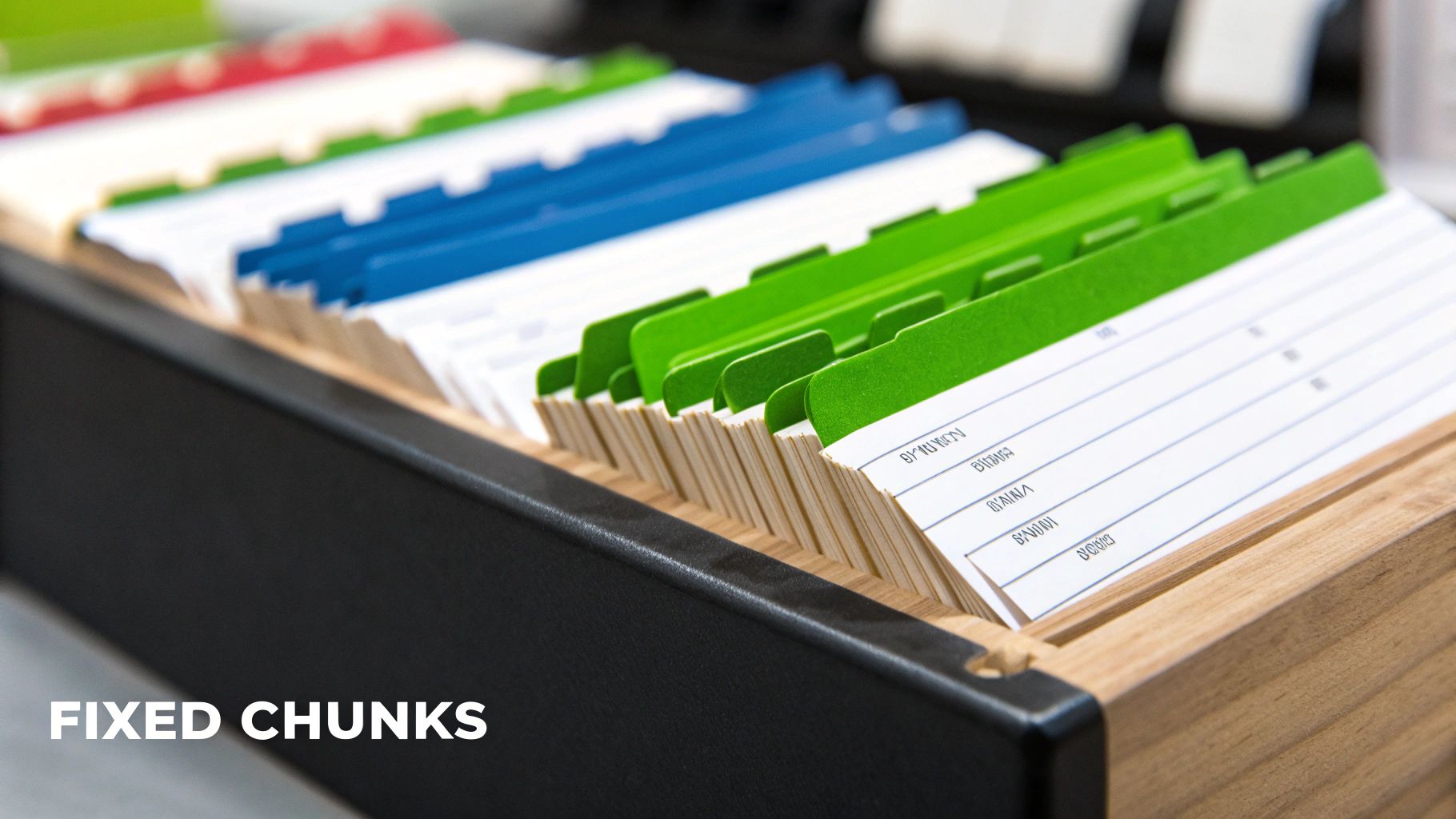
Fixed-size chunking is the foundational method in RAG chunking strategies, acting as a reliable and straightforward starting point for any RAG system. This technique works by systematically dividing documents into uniform segments of a predetermined length, such as 512 or 1024 tokens. An optional overlap between consecutive chunks helps preserve contextual continuity, ensuring that ideas aren't abruptly severed at the boundary, which can harm retrieval.
Its primary strength lies in its simplicity and computational efficiency. Since it doesn't require complex semantic analysis, fixed-size chunking is fast, language-agnostic, and easy to implement. This makes it an excellent baseline for standardizing document processing and ensuring every piece of your knowledge base is indexed for retrieval.
How It Works & Key Parameters
The process is simple: the text is tokenized and then split into chunks of a specified size (chunk_size). A secondary parameter, chunk_overlap, dictates how many tokens from the end of one chunk are repeated at the beginning of the next. This overlap is a critical tool for improving retrieval, as it ensures that a single query can match context that might otherwise be split across two separate chunks. For example, a 1000-character text with a chunk size of 200 and overlap of 40 would produce chunks that share the last 40 characters of the preceding segment.
Best Practices & Implementation Tips
To effectively implement fixed-size chunking for better retrieval, follow these actionable guidelines:
- Align with Your Embedding Model: Set your
chunk_sizebased on the context window of your embedding model. Common models liketext-embedding-ada-002orall-mpnet-base-v2perform best with sizes between 256 and 1024 tokens. A chunk that is too large can dilute the meaning of its embedding. - Use Strategic Overlap for Context: A
chunk_overlapof 10-20% of your chunk size is a strong heuristic. This ensures that sentences or ideas split across chunks are fully captured in at least one of the segments, improving the chances of a successful retrieval. - Empirically Test for Your Data: There is no universal "best" size. You must test different
chunk_sizeandchunk_overlapvalues on a representative sample of your documents to find the sweet spot that yields the most relevant search results. - Leverage Visualization Tools: Tools like ChunkForge allow you to visually inspect how different parameters split your documents. Use its drag-and-drop resizing feature to quickly iterate and find the optimal balance between chunk size and context preservation before committing to a full pipeline run.
When to Use Fixed-Size Chunking
This method excels in scenarios requiring speed, simplicity, and uniformity. It's an excellent baseline for any new RAG project, especially when working with large volumes of semi-structured or unstructured documents where more complex parsing is not immediately necessary. Use it to quickly index your entire knowledge base and establish a benchmark for retrieval performance.
2. Semantic Chunking
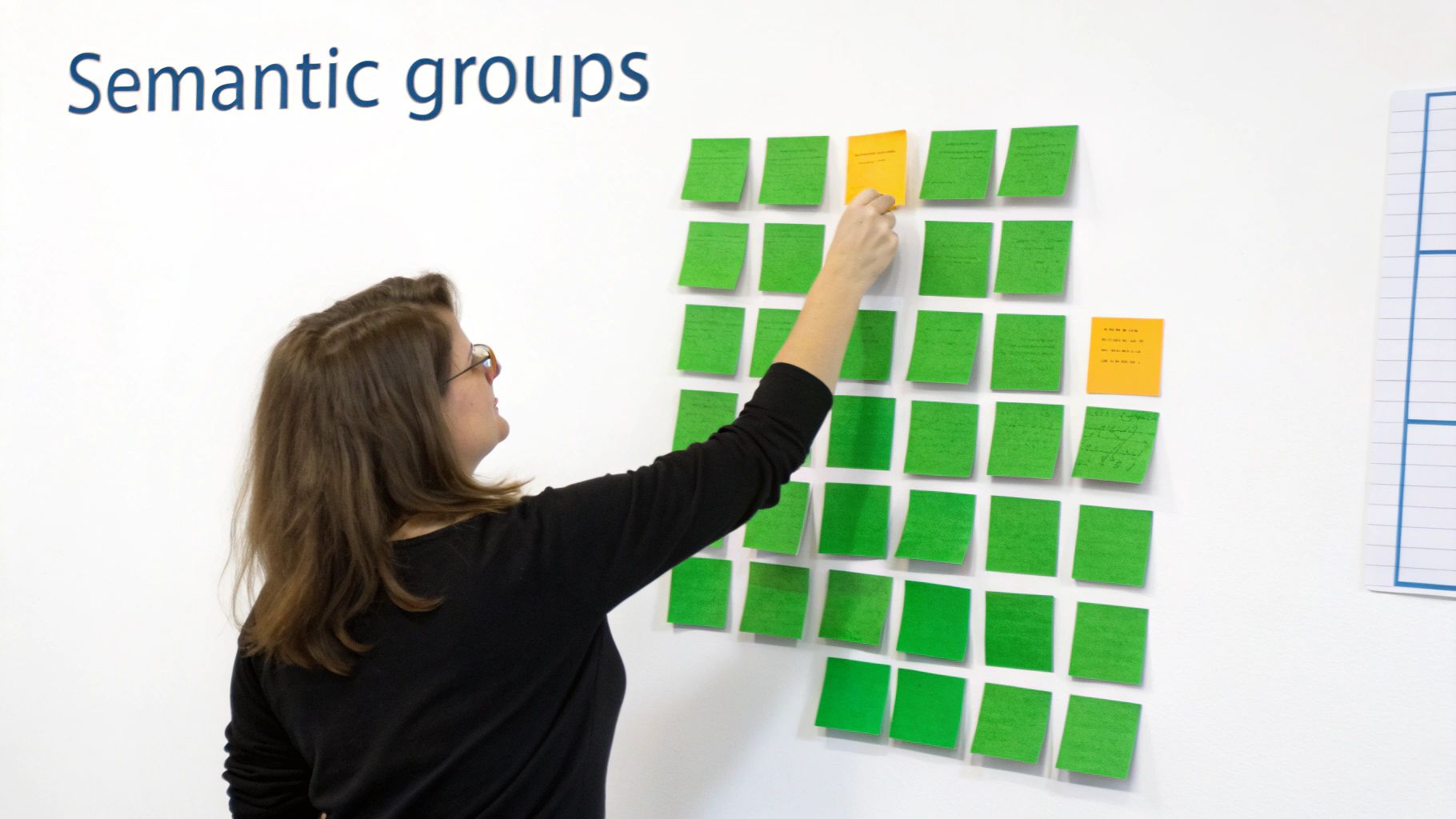
Semantic chunking moves beyond arbitrary divisions to create segments based on meaning and contextual relevance, directly aiming to improve retrieval quality. This intelligent strategy analyzes the semantic relationships between sentences, grouping them into coherent passages where topics are consistent. Instead of splitting text at a fixed token count, it identifies natural breakpoints where the topic shifts, ensuring each chunk represents a complete idea or thought.
This method significantly enhances retrieval accuracy because the resulting chunks are contextually self-contained. When a user query matches a chunk, the retrieved information is more likely to be a complete, relevant answer rather than a fragmented snippet, directly improving the quality of retrieval augmented generation systems.
How It Works & Key Parameters
The process involves embedding each sentence and calculating the cosine similarity between adjacent sentences. A significant drop in similarity indicates a topic change, which becomes a natural boundary for a new chunk. The key parameter is the similarity_threshold (or breakpoint_threshold), a value that determines how different two sentences must be to trigger a split. This threshold directly controls the granularity of your chunks, which in turn affects retrieval.
Best Practices & Implementation Tips
To effectively implement one of the most powerful rag chunking strategies for retrieval, consider these actionable guidelines:
- Calibrate Your Similarity Threshold: Start with a threshold between 0.80 and 0.95 for models like OpenAI's
text-embedding-3-small. A higher value (e.g., 0.95) creates smaller, more granular chunks ideal for fact-based retrieval, while a lower value (e.g., 0.80) produces larger, more broadly themed chunks suitable for conceptual queries. - Use Domain-Specific Models for Better Boundaries: For specialized content like medical or legal documents, fine-tuned or domain-specific embedding models will produce more accurate similarity scores. This leads to better chunk boundaries and more precise retrieval.
- Cache Embeddings to Iterate Faster: Semantic chunking requires embedding every sentence, which can be computationally expensive. Cache these embeddings to avoid reprocessing documents and speed up experimentation with different thresholds.
- Preview with Tooling: Use a tool like ChunkForge to visually test different threshold values. Its semantic strategy preview allows you to see exactly where the splits occur in your documents, helping you fine-tune the threshold for optimal retrieval results before processing your entire dataset.
When to Use Semantic Chunking
Semantic chunking is ideal for knowledge bases where contextual integrity is paramount for retrieval. Use it for dense, long-form content like research papers, legal contracts, or detailed product documentation. This approach ensures that retrieved segments provide complete, coherent answers, making it a superior choice when the relevance of retrieved context is the primary goal. If you want to learn more about the role of semantics in NLP, it's a foundational concept for advanced RAG.
3. Paragraph-Based Chunking
Paragraph-based chunking is a structure-aware strategy that leverages the natural semantic boundaries of a document: its paragraphs. This method treats each paragraph as an individual chunk, preserving the author's intentional organization of ideas. This alignment with the document's inherent structure often produces chunks that are easier for retrieval models to match against user queries.
The core advantage of this approach for retrieval is its ability to maintain high contextual integrity. By respecting document formatting, it ensures that related sentences stay together, leading to more coherent and meaningful embeddings that are more likely to match a user's query intent.
How It Works & Key Parameters
This technique splits text based on paragraph delimiters, most commonly double newlines (\n\n). Once split, paragraphs can be treated as individual chunks. To optimize for retrieval, you can set minimum and maximum size constraints. Small, consecutive paragraphs can be grouped together to form a more substantial chunk with richer context, while overly long paragraphs can be subdivided using a secondary method like fixed-size splitting to avoid diluting the chunk's semantic focus.
Best Practices & Implementation Tips
To get the most out of paragraph-based chunking for retrieval, follow these actionable guidelines:
- Normalize Paragraph Delimiters: Before processing, clean your documents to ensure consistent paragraph breaks. Replace various delimiters (like
\r\nor single newlines followed by indentation) with a standard marker (\n\n) for reliable splitting. - Group Small Paragraphs to Add Context: Avoid creating tiny, low-context chunks from single-sentence paragraphs or list items, as these perform poorly in retrieval. Set a minimum token count and merge consecutive small paragraphs until the threshold is met. This enriches the contextual information in each chunk.
- Set a Sensible Maximum to Maintain Focus: Extremely long paragraphs can exceed your embedding model's context window or become too general. Implement a maximum chunk size to split these larger paragraphs, ensuring they remain focused and processable.
- Visualize and Validate: Use a tool like ChunkForge to preview how its Paragraph strategy segments your documents. Experiment with size constraints to see how it groups or splits paragraphs, allowing you to validate your configuration for optimal retrieval on specific document formats before scaling.
When to Use Paragraph-Based Chunking
This method is ideal for processing structured and semi-structured text where paragraphs serve as meaningful units of information. It is highly effective for technical documentation, blog posts, news articles, and markdown-based knowledge bases. Use paragraph-based chunking when you want to create semantically coherent chunks that directly reflect the document's intended structure, leading to more precise and context-aware retrieval.
4. Heading-Based Chunking (Hierarchical)
Heading-based chunking is a structure-preserving strategy that leverages the inherent hierarchy of a document, using headings and subheadings as natural boundaries for segmentation. This method treats the content under each heading as a single, contextually coherent unit, which is highly effective for retrieval because queries often map to specific sections of a document.
Its core advantage is its ability to create chunks that are not only contextually rich but also scoped to a specific topic. By preserving the context defined by sections and subsections, this strategy ensures that retrieved information is highly relevant and directly addresses the implicit topic of a user's query. This makes it one of the most effective rag chunking strategies for well-structured content.
How It Works & Key Parameters
This technique parses a document, typically in a format like Markdown or HTML, and identifies heading levels (e.g., H1, H2, H3). It then splits the text based on these markers, grouping all content that falls under a specific heading into a single chunk. For instance, everything following an H2 up to the next H2 would become one chunk. To optimize for retrieval, you can also prepend the heading itself to the chunk text to provide stronger contextual signals to the embedding model.
A critical secondary step involves setting a maximum chunk size. If a section exceeds this limit, it can be recursively split using a smaller heading level or a fallback method like fixed-size chunking. This prevents chunks from becoming too large and losing focus.
Best Practices & Implementation Tips
To effectively implement heading-based chunking for better retrieval, consider these actionable guidelines:
- Enrich Chunks with Metadata: Store the heading hierarchy as metadata within each chunk (e.g.,
{'H1': 'Introduction', 'H2': 'Core Concepts'}). This metadata is invaluable for enabling filtered semantic searches or re-ranking results based on section relevance. - Validate Document Structure: Before processing, ensure your source documents have a clean and consistent heading structure. Inconsistent or missing headings will degrade chunk quality and retrieval performance.
- Set a Max Size Fallback: Always define a maximum token limit for chunks. This prevents extremely long sections from creating oversized embeddings that lose granular detail and perform poorly in retrieval.
- Visualize the Hierarchy: Use tools like ChunkForge to apply the heading-based strategy and visually inspect the results. This allows you to confirm that the document's intended structure is being captured correctly, ensuring your chunks are optimized for retrieval.
When to Use Heading-Based Chunking
This method is ideal for any document with a clear, hierarchical organization. It excels with technical documentation, API references, legal agreements, academic papers, and user manuals. Use it whenever preserving the logical flow and sectional context is critical for enabling precise, topic-specific retrieval in your RAG system.
5. Recursive/Hybrid Chunking
Recursive chunking, often used in hybrid strategies, offers an adaptive and context-aware approach to document segmentation designed to create semantically coherent chunks. This technique applies a series of separators hierarchically, starting with the broadest structural delimiters (like paragraphs) and progressively moving to finer ones (like sentences) only when a chunk exceeds a specified size limit.
Its main advantage for retrieval is its flexibility. Instead of forcing a uniform size, it respects the natural structure of the document first, resulting in chunks that are more meaningful for an embedding model to process. This balance between semantic coherence and size constraints makes it one of the most effective and popular RAG chunking strategies for improving retrieval across diverse document types.
How It Works & Key Parameters
The core of this method lies in a prioritized list of separators, such as ["\n\n", "\n", " ", ""]. The text is first split by the highest-priority separator (double newlines for paragraphs). If any resulting segment is still too large, it is then recursively split by the next separator in the list (single newlines for sentences), and so on, until all chunks are within the defined chunk_size.
This method intelligently combines the principles of structural and fixed-size chunking. It attempts to create meaningful splits first and only falls back to character-level splits as a last resort, which is a key technique in intelligent document processing pipelines.
Best Practices & Implementation Tips
To get the most out of recursive chunking for retrieval, follow these guidelines:
- Order Separators Logically: Arrange your list of separators from the most significant structural element to the least. A common and effective sequence is
["\n\n", "\n", ". ", " ", ""]to prioritize paragraphs, then sentences, which maximizes the semantic integrity of the resulting chunks. - Test Your Separator Sequence: Before full implementation, run your chosen separator sequence on a representative sample of your documents. Some formats may use different delimiters (e.g.,
\r\nor custom markers) that you need to account for. - Avoid Over-Splitting: Set a reasonable
chunk_sizethat doesn't force the algorithm to frequently fall back to its final, fine-grained separators. This helps maintain the high-level semantic context needed for good retrieval. - Leverage Hybrid Approaches: In ChunkForge, you can test a recursive strategy by defining a custom separator list. This allows you to visually validate how the hierarchy works on your specific content before integrating it into your RAG pipeline.
When to Use Recursive/Hybrid Chunking
This strategy is the go-to choice for processing semi-structured text like Markdown, code, or documents with clear paragraph and sentence boundaries. It excels when you need to preserve the logical flow of information while still adhering to size constraints. It is widely considered a best-practice default for building robust and accurate RAG systems with high retrieval performance.
6. Token-Based Chunking
Token-based chunking is a more precise and model-aware approach that aligns directly with how Large Language Models (LLMs) process information. Instead of splitting text by character or word counts, this technique divides documents based on the number of tokens, which are the fundamental units of text (words, sub-words, or characters) that models like GPT-4 actually consume.
Its core advantage for retrieval is its precision. By using the same tokenizer as the target embedding model, this method guarantees that each chunk fits perfectly within the model's context window. This prevents unexpected truncation, which silently discards information and harms retrieval, and maximizes the relevance of the retrieved context.
How It Works & Key Parameters
The process involves first selecting a tokenizer that matches your LLM, such as tiktoken for OpenAI models or a tokenizer from the Hugging Face transformers library. The document is then tokenized, and the resulting list of token IDs is split into segments of a specified chunk_size (in tokens). Like other methods, a chunk_overlap parameter, also measured in tokens, ensures contextual continuity between chunks and improves retrieval across boundaries.
Best Practices & Implementation Tips
To effectively implement token-based chunking for optimal retrieval, follow these specific guidelines:
- Match Your Tokenizer: Always use the tokenizer that corresponds to your downstream embedding model. Using a different one will lead to inaccurate token counts, potentially causing context overflow or underutilization, both of which degrade retrieval performance.
- Maintain a Safety Buffer: Reserve 10-15% of your model’s maximum context window as a buffer. This accommodates special tokens added by the model and prevents errors that could stop the retrieval process.
- Implement Token-Based Overlap: Ensure your
chunk_overlapis also defined in tokens, not characters. This maintains consistency and provides a more accurate contextual bridge between chunks for the retrieval model to leverage. - Verify Counts in Tooling: When using tools like ChunkForge, select the appropriate tokenizer (e.g., "GPT-4") from the settings. This ensures the visualized chunk sizes and token counts precisely match what your RAG system will process, allowing for accurate tuning.
When to Use Token-Based Chunking
This method is essential for production-grade RAG systems where performance, cost, and reliability are critical. It is the recommended approach when you need to guarantee that chunks will not exceed the context limits of your chosen models. Use it to avoid silent data truncation and ensure every token indexed contributes meaningfully to the retrieval and generation process.
7. Sentence-Based Chunking
Sentence-based chunking is a more granular and semantically aware approach among RAG chunking strategies. This technique leverages natural language processing (NLP) to split documents precisely at sentence boundaries. By doing so, it creates highly focused chunks that preserve full grammatical and logical units.
The key advantage of this method for retrieval is its precision. Unlike fixed-size methods that can arbitrarily slice sentences in half, sentence-based chunking ensures that each chunk represents a complete thought. This leads to more focused embeddings that are easier for a retrieval system to match against specific, fact-based queries, directly enhancing retrieval accuracy for question-answering systems.
How It Works & Key Parameters
The process relies on a sentence tokenizer, typically from a library like NLTK or spaCy, to identify sentence endpoints. The primary parameter is a grouping strategy, which dictates how many consecutive sentences are combined into a single chunk. For example, grouping 3-5 sentences can provide sufficient context for retrieval without introducing noise. This grouping prevents over-fragmentation while retaining semantic focus. An optional max_chunk_size can be used as a safeguard to split overly long sentence groups.
Best Practices & Implementation Tips
To effectively implement sentence-based chunking for improved retrieval, consider these actionable guidelines:
- Choose the Right Library: Use robust sentence tokenizers from libraries like spaCy (for its speed and accuracy) or NLTK. For non-English content, ensure you select a tokenizer trained specifically for that language to ensure accurate sentence splitting.
- Group Sentences Strategically: Start by grouping 3-5 sentences per chunk. This often provides enough context for the embedding model to capture meaning effectively. Test different group sizes to see what works best for your data and query types.
- Handle Edge Cases: Be mindful of abbreviations (e.g., "Dr." or "U.S.A."), numbered lists, and ellipses that can be mistaken for sentence terminators. Test your tokenizer on your specific document types to ensure it handles these cases correctly.
- Combine with Size Constraints: Set a maximum token limit for your sentence groups. If a group exceeds this limit, you can split it to maintain compatibility with your embedding model's context window, preventing retrieval errors.
When to Use Sentence-Based Chunking
This method is ideal for applications where factual precision is paramount for retrieval, such as question-answering systems, legal document analysis, and customer support knowledge bases. It excels with structured prose where sentence structure is consistent. Use it when you need to create highly relevant, self-contained chunks that map directly to specific facts, ensuring the retrieval system pulls the most precise information possible.
8. Metadata-Aware Chunking with Enrichment
Metadata-aware chunking with enrichment elevates the chunking process from a simple text-splitting task to a strategic data-layering operation designed for precision retrieval. This advanced method involves not only dividing documents but also annotating each chunk with a rich layer of contextual metadata. This metadata can include generated summaries, extracted keywords, entities, and hierarchical tags, providing the retrieval system with powerful signals beyond the raw text.
This approach transforms chunks into structured, self-descriptive data objects. By enriching chunks with this additional context, retrieval systems can perform far more precise and sophisticated filtering and searching. For instance, a system could retrieve only chunks tagged as "Clinical Trial Results" from a specific author, a level of granularity impossible with basic chunking methods and a game-changer for retrieval performance.

How It Works & Key Parameters
The process begins with standard chunking, followed by a metadata enrichment pipeline. For each text chunk, an LLM or other specialized model extracts or generates relevant information. This often includes extracting entities like names and dates, generating a concise summary, and assigning predefined tags. This information is then stored alongside the chunk's vector embedding in a database that supports metadata filtering, enabling a "filter-then-search" retrieval strategy. The key is to design a metadata schema that aligns with the domain-specific search patterns your application needs.
<iframe width="560" height="315" src="https://www.youtube.com/embed/tmiBae2goJM" frameborder="0" allow="accelerometer; autoplay; clipboard-write; encrypted-media; gyroscope; picture-in-picture" allowfullscreen></iframe>Best Practices & Implementation Tips
To successfully implement one of the most powerful rag chunking strategies for retrieval, focus on the quality and structure of your metadata:
- Define a Typed JSON Schema: Create a clear, structured schema for your metadata that matches your domain requirements. This enables reliable, predictable filtering to narrow down the search space for the vector search.
- Leverage LLMs for High-Quality Extraction: Use powerful models like GPT-4 or Claude for generating high-fidelity summaries and extracting complex relationships. The quality of your enrichment directly impacts retrieval accuracy.
- Create Hierarchical Tags for Faceted Search: Implement a tagging system with multiple levels (e.g., category → subcategory → topic) to enable multi-faceted and drill-down search capabilities, drastically improving retrieval precision.
- Incorporate Source Mapping for Citations: Always include metadata that links a chunk back to its source document and page number. This is critical for verification and providing citations in the final RAG output.
- Use Visual Tools for Iteration: Tools like ChunkForge are purpose-built for this strategy. Use its interface to visually adjust chunk boundaries and immediately see how the generated metadata changes, allowing for rapid optimization of your retrieval layer. If you're interested in the underlying technology, you can learn more about named entity recognition here.
When to Use Metadata-Aware Chunking
This strategy is ideal for enterprise-grade RAG systems where precision, governance, and complex querying are paramount. It is essential for domains like healthcare (filtering patient records by clinical metadata), legal (searching case files by legal precedents), and e-commerce (powering faceted search). Use this method when your users need to filter results before performing a semantic search to guarantee relevance.
Comparison of 8 RAG Chunking Strategies
| Strategy | 🔄 Implementation complexity | ⚡ Resource requirements | ⭐ Expected outcomes | 📊 Ideal use cases | 💡 Key advantages |
|---|---|---|---|---|---|
| Fixed-Size Chunking | Low — simple deterministic split | Low — predictable compute & storage | Medium — consistent but may cut semantics | General-purpose RAG, production pipelines | Fast, easy to implement; consistent indexing |
| Semantic Chunking | High — embedding models & tuning | High — embedding calls, caching needed | High — coherent, highly relevant retrieval | Domain-specific QA, research papers, technical docs | Preserves meaning; improves relevance |
| Paragraph-Based Chunking | Low–Medium — detects paragraphs | Low — minimal compute if well-formatted | Medium — coherent when source is structured | Articles, markdown, documentation, blogs | Respects author structure; simple hybrid-friendly |
| Heading-Based Chunking (Hierarchical) | Medium — heading detection & nesting | Medium — metadata storage, moderate compute | High — preserves hierarchy and scoped retrieval | Technical docs, APIs, manuals, structured reports | Maintains document hierarchy; precise retrieval |
| Recursive/Hybrid Chunking | Medium–High — multi-level rules to tune | Medium — recursive splits add overhead | High — balances coherence and size constraints | Mixed-format corpora, large-scale RAG systems | Adaptive splitting; keeps higher-level context |
| Token-Based Chunking | Medium — integrate model tokenizers | Low–Medium — tokenizer init, accurate budgeting | High — exact context-window alignment | Production RAG, cost-sensitive, multi-model systems | Prevents token overruns; precise context control |
| Sentence-Based Chunking | Medium — NLP sentence detection | Medium — NLP libs, moderate processing | Medium — grammatically complete, fine-grained | QA systems, customer support, news/content | Avoids mid-sentence cuts; good granularity |
| Metadata-Aware Chunking with Enrichment | High — extraction, schemas, LLMs | High — LLM/NER compute, storage for metadata | Very High — precise filtering, governance-ready | Enterprise RAG, healthcare, legal, regulated data | Rich filtering, better reranking, auditability |
Choosing Your Strategy: From Theory to Production
We have navigated the diverse landscape of RAG chunking strategies, moving from the foundational simplicity of Fixed-Size Chunking to the sophisticated, context-aware power of Metadata-Aware Enrichment. The central lesson is clear: chunking is not a one-time setup, but a critical, iterative process that directly governs the performance and reliability of your Retrieval-Augmented Generation system. Your choice of strategy is the bedrock upon which retrieval accuracy is built.
The journey from a theoretical understanding to a production-ready RAG pipeline requires a shift in mindset. Instead of searching for a single "best" method, the goal is to find the optimal method that maximizes retrieval relevance for your specific data and use case. An unstructured transcript from a customer call demands a different approach, perhaps Semantic or Sentence-Based Chunking, than a highly structured technical manual, which would benefit immensely from Heading-Based or Recursive strategies.
Synthesizing Your Approach: Key Takeaways
The most effective RAG systems often don't rely on a single, rigid strategy. They employ a hybrid, data-centric approach guided by continuous evaluation to optimize retrieval. As you move forward, keep these core principles at the forefront of your development process:
- Content is King: The structure of your source documents is the single most important factor influencing retrieval. Always start with a thorough analysis of your data. Is it prose, code, or tables? The answer will immediately narrow down your most viable options.
- Experimentation is Non-Negotiable: Never assume your first choice is the best. Isolate a representative subset of your documents and rigorously test at least two or three promising RAG chunking strategies. Small-scale experiments will save you massive headaches and lead to better retrieval.
- Evaluation Drives Improvement: You cannot improve what you cannot measure. Implement core retrieval metrics like Hit Rate, Mean Reciprocal Rank (MRR), and Precision@K early in your workflow. These quantitative signals are your compass for improving retrieval accuracy.
- Metadata is a Superpower: The leap from good to great retrieval performance often lies in metadata. Strategies that enrich chunks with contextual information unlock powerful filtering and routing capabilities that dramatically reduce irrelevant results.
Actionable Next Steps: A Practical Roadmap
Moving from theory to implementation can feel daunting. Here is a practical, step-by-step plan to systematically improve your system’s retrieval quality by mastering RAG chunking strategies.
- Audit Your Data: Categorize your source documents. For each category (e.g., PDFs, Markdown files), identify the dominant structural patterns that can be leveraged for better chunking.
- Formulate a Hypothesis: Based on your audit, select two primary chunking strategies to compare. For example, hypothesize that for your Markdown knowledge base, Heading-Based Chunking will yield a higher retrieval hit rate than simple Recursive Chunking.
- Implement and Test: Using a dedicated evaluation set of questions and known-good answers, process your test documents with both strategies. Generate embeddings and run your retrieval evaluation suite to gather quantitative results.
- Analyze and Iterate: Compare the metrics. Dig into the retrieval failures. Did one strategy create chunks that were too small and lacked context? Did another create chunks that were too large and diluted the key information? Use these insights to refine your parameters or test a new hybrid approach.
- Leverage a Visualizer: Throughout this process, use a tool that allows you to see the chunks being created. Visual inspection is an invaluable sanity check that helps you build intuition and spot systematic errors that metrics alone might miss.
By embracing this deliberate, iterative, and data-driven methodology, you transform chunking from a technical chore into a strategic advantage. Mastering these RAG chunking strategies is the most direct path to building AI applications that are not just functional, but genuinely accurate, reliable, and trustworthy because they can retrieve the right information at the right time.
Ready to stop guessing and start visualizing your chunking strategies? ChunkForge provides an interactive workbench to test, compare, and perfect your chunking logic in real-time before writing a single line of production code. Sign up for early access and see how the right tooling can transform your RAG development workflow at ChunkForge.