Enterprise Document Management: Optimizing Document Pipelines for RAG Retrieval
Discover enterprise document management fundamentals to build AI-ready data pipelines that boost retrieval accuracy and performance in RAG systems.

Enterprise document management isn't what it used to be. Forget dusty digital filing cabinets built just for archiving and compliance. In the age of AI, your document system is the active, beating heart of any high-performing Retrieval-Augmented Generation (RAG) system.
A modern, RAG-focused approach is about transforming static documents into discoverable, context-rich assets that are primed to deliver the precise information your models need for high-quality retrieval.
Rethinking Document Management for the AI Era
For AI and LLM teams, traditional enterprise document management systems are a serious bottleneck. These legacy platforms were built for humans to store and find things, not for the semantic needs of an AI. They treat your PDFs and Word docs like opaque boxes, keeping all the valuable information trapped inside and hampering retrieval performance.
Think of it like setting up a library for a brilliant researcher—in this case, your Large Language Model (LLM). A traditional system just shoves the books onto shelves. A modern, RAG-ready system, on the other hand, creates a rich "card catalog" for every single paragraph, complete with cross-references, summaries, and keywords. This makes the content instantly understandable and retrievable for the researcher.
That shift—from passive storage to active, intelligent preparation—is what separates a mediocre RAG system from a truly reliable one.
The Growing Need for Intelligent Systems
This isn't just a niche problem for AI teams; it’s a reflection of a much bigger trend. As the mountain of digital information grows taller every day, companies are scrambling for better ways to make sense of it all.
This is fueling explosive growth in the enterprise document management market, which shot up to USD 7.16 billion in 2025 and is on track to hit USD 15.18 billion by 2032.
That growth is a clear signal that just "storing" files isn't enough anymore. For RAG applications, the quality of what you retrieve directly dictates the quality of what you generate.
A smart enterprise document management strategy is the difference between an AI that gives you vague, generic answers and one that delivers sharp, contextually aware insights pulled directly from your own knowledge base.
From Static Storage to Dynamic AI Asset
So, what's the point of modernizing your document management? It's all about prepping your unstructured data to maximize retrieval accuracy in your RAG pipeline. This requires a fundamental change in how you handle documents from the moment they arrive.
The main goals are:
- Intelligent Ingestion: This is way more than just a file upload. It’s about having systems that can crack open complex formats, pull out the text, and understand structural elements like tables and headers to preserve context.
- Metadata Enrichment: You want to automatically tag documents with useful metadata—think summaries, keywords, dates, and authors. This metadata becomes an incredibly powerful signal for filtering and refining search results during retrieval.
- Structured Preparation: This means breaking down massive documents into smaller, meaningful chunks optimized for vectorization and semantic search. It ensures your RAG system retrieves the most relevant, bite-sized piece of context for the LLM.
Nailing these principles turns your document repository from a data graveyard into a powerful, queryable knowledge source that directly improves your RAG system's retrieval performance. For a deeper dive, check out our guide on document management system best practices.
Traditional Vs RAG-Optimized Document Management
The difference between a legacy EDM and a RAG-optimized one is night and day. One is built for hoarding data; the other is built for activating it for precise retrieval.
| Feature | Traditional EDM | RAG-Optimized EDM |
|---|---|---|
| Primary Goal | Secure storage, compliance, and human-led retrieval. | Prepare documents as context-rich assets for AI retrieval. |
| Document View | Opaque containers (e.g., a PDF is just a file). | Granular content (text, tables, images are separate items). |
| Ingestion Process | Simple file upload with basic, often manual, metadata. | Automated parsing, text extraction, and metadata enrichment. |
| Core Technology | Keyword search, folder hierarchies. | Vectorization, semantic search, and structured chunking. |
| Key Output | A list of relevant documents for a human to read. | Precise, context-rich chunks for an LLM to process. |
| Success Metric | "Did I find the right document?" | "Did I retrieve the perfect context to answer the query?" |
Ultimately, a RAG-optimized system doesn't just store documents; it understands them. This foundational shift is what enables you to build next-generation AI applications that are accurate, reliable, and deeply informed by your proprietary data.
Building Your RAG-Ready Document Pipeline
Turning a messy pile of raw documents into fuel for a Retrieval-Augmented Generation (RAG) system is a lot like a chef prepping ingredients for a five-star meal. You wouldn't just toss whole, unwashed vegetables into a pot and expect a masterpiece. You have to clean, chop, and season them first.
It’s the same with your documents. A RAG-ready pipeline isn't just about storing files; it's about meticulously transforming them into retrieval-optimized assets. Each step is designed to make sure your AI gets the most precise, context-rich information possible. Skip these steps, and your retrieval will suffer—and your AI's answers will be just as bad.
The diagram below shows the high-level flow from chaotic, unstructured documents to the kind of intelligent, AI-ready data we're aiming for.
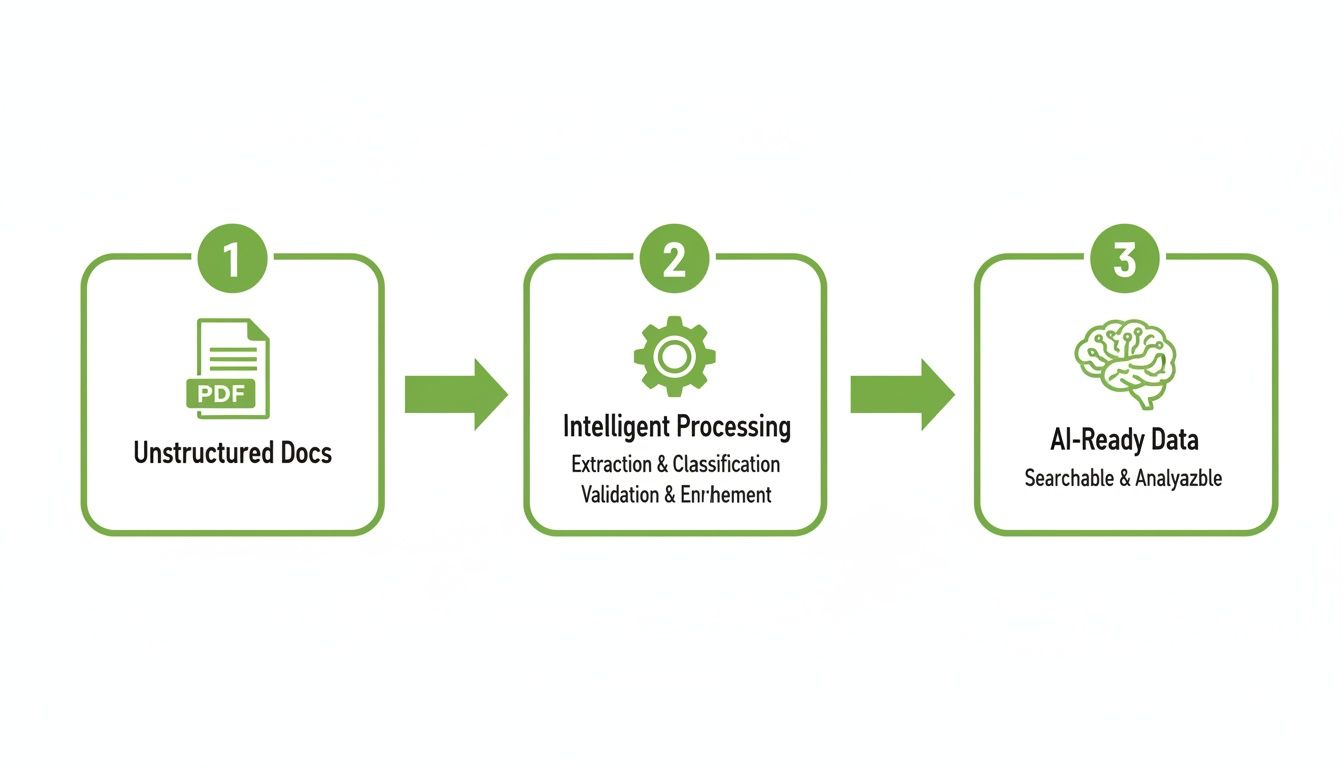
This is the core of any modern enterprise document management strategy built for AI: turning raw files into a structured, searchable knowledge base that boosts retrieval quality.
Ingestion and Pre-processing: The Foundation
It all starts with ingestion. This is where your system consumes documents in every format imaginable—from complex PDFs and DOCX files to clean Markdown. We use tools like Optical Character Recognition (OCR) here to pull text from scanned documents and images, ensuring all potential knowledge is captured.
Right after ingestion comes pre-processing. Think of this as the cleanup crew. The raw text gets a good scrub—we remove junk characters, standardize the formatting, and identify key structural elements like headers, lists, and tables. This ensures the text is clean and logically organized for chunking.
Chunking: The Core of RAG Readiness
With clean text in hand, we move on to chunking, arguably the most critical step for RAG retrieval. You can’t just shove a 100-page PDF into an LLM's context window; it's way too big. Chunking breaks that massive document down into smaller, focused pieces.
Your chunking strategy has a direct impact on retrieval quality, so it’s important to get it right.
- Fixed-Size Chunking: This is the simplest method. It just splits text into chunks of a set length, say, 500 characters. It's fast, but you often end up slicing sentences in half and losing crucial context, which harms retrieval.
- Semantic Chunking: This is the smart way. It uses AI models to find natural breaks in meaning, grouping related sentences together. This creates highly coherent chunks that are ideal for semantic search, leading to more relevant results.
- Metadata-Based Chunking: This approach uses the document's own structure—like its headings and sections—to decide where to split. For instance, you could create a new chunk for every
H2heading, which keeps the document's logical flow intact and improves context.
The real goal of chunking isn't just to make text smaller. It's to create self-contained, contextually complete units of information that give the RAG system a perfect, bite-sized answer to retrieve.
Enrichment: Creating Powerful Retrieval Signals
The final step is enrichment, where we layer valuable metadata onto each chunk. This is what turns a simple piece of text into a powerful, filterable asset in your vector database. It’s like putting detailed labels on all your prepped ingredients so your retrieval system can find the exact one it needs in a hurry.
During enrichment, you might generate:
- Summaries: A quick overview of what the chunk is about.
- Keywords: Important terms and entities mentioned in the text for hybrid search.
- Source Information: The original document name, page number, and section header for traceability.
- Custom Tags: Business-specific labels like "Q4 Financial Report" or "Technical Specification" for precise filtering.
This rich metadata enables powerful hybrid search. An engineer could search for a technical concept while also filtering for documents from a specific author or date range, drastically improving retrieval precision. To dive deeper, check out our complete guide on building a RAG pipeline.
By nailing each of these steps—ingestion, pre-processing, chunking, and enrichment—you transform a static library of documents into a dynamic, intelligent knowledge base that helps your AI deliver truly exceptional results.
Designing Your Architecture for Better Retrieval
Once your document pipeline is busy turning raw files into clean, enriched chunks, the next big job is designing an architecture that maximizes retrieval effectiveness. This is where all those individual components start working together as a cohesive system. A solid architecture doesn't just store data; it organizes it for speed, accuracy, and—most importantly—the kind of contextual relevance your RAG applications need to thrive.
The absolute heart of this architecture is the document-to-chunk-to-vector workflow. Think of it as a chain of custody for your data. This process ensures every piece of information your LLM uses isn't just a random snippet but a verifiable piece of a much larger puzzle. It connects the dots from the AI's answer all the way back to the original source.
Building Traceable Data Pipelines
One of the biggest challenges with RAG systems is the "black box" problem. When an LLM gives an answer, how do you know it's right? Where did that specific fact come from? This is where traceability becomes non-negotiable. It’s the foundation for building trust and makes debugging retrieval issues infinitely less painful.
Your architecture must maintain a crystal-clear map that links every vector embedding back to its parent chunk. That chunk, in turn, needs to point back to its source document and even the specific page number. You're essentially creating an auditable trail, which is critical for any system running in production.
Here’s a quick look at how this traceability map functions, connecting a vector all the way back to its home inside a document.
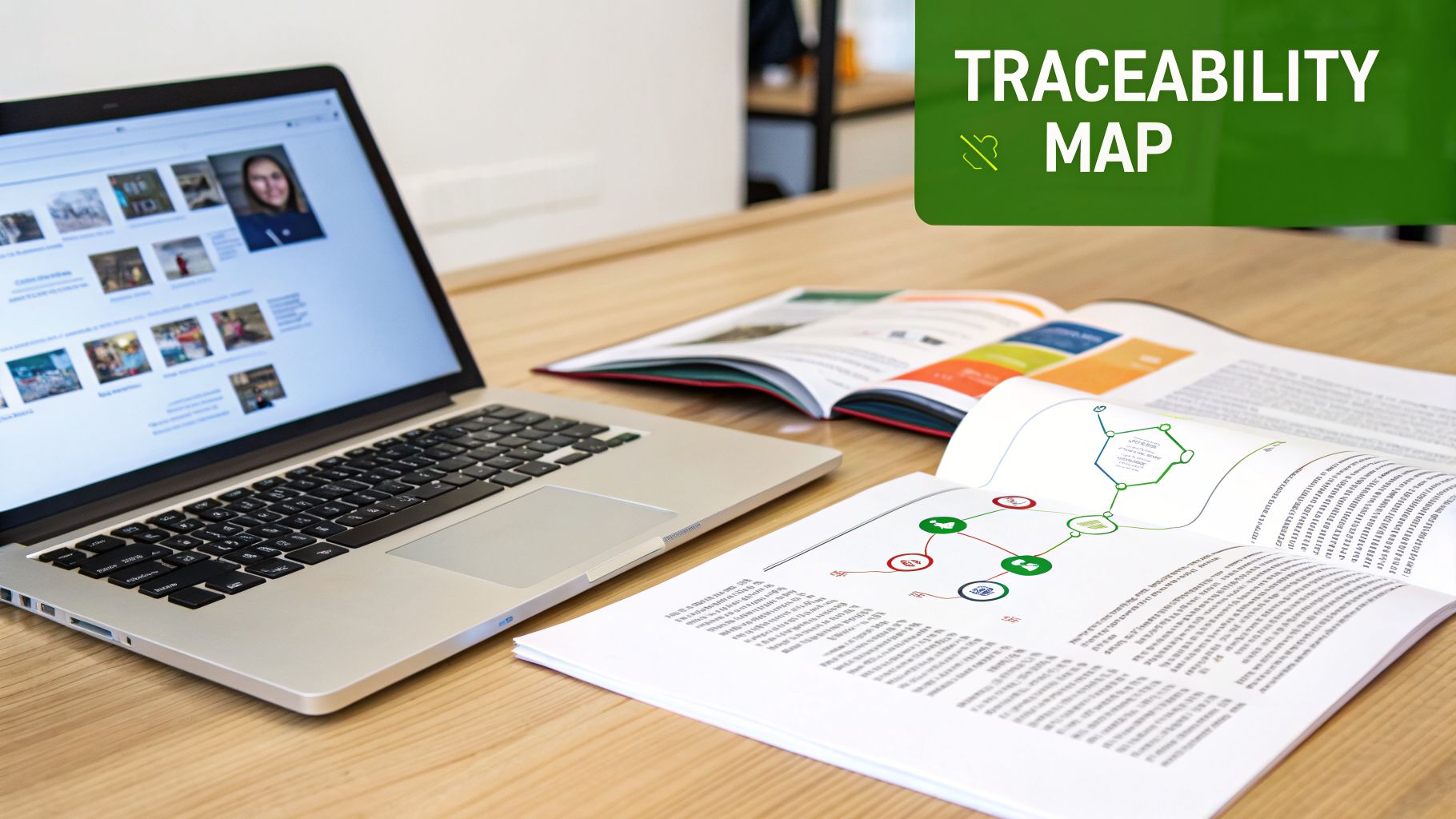
This mapping isn't just good housekeeping; it's your lifeline when you need to verify context or figure out why your RAG system retrieved an irrelevant chunk, leading to a "hallucinated" response.
This connection lets developers instantly check the source of any retrieved context, making sure the LLM is pulling from the right information. It's a fundamental piece of any reliable enterprise document management system built for AI.
Integrating with Vector Databases
Okay, so you have your processed chunks and all their juicy metadata. Where do they live? In a vector database. This is where the magic of semantic search really happens. Tools like Pinecone, Weaviate, or Chroma are built for this. Your architecture needs a smart way to get data into this database and query it efficiently.
An effective, event-driven workflow to optimize this is:
- A new document gets dropped into your storage, like an Amazon S3 bucket.
- That event automatically triggers a processing function (an AWS Lambda function is perfect for this).
- The function grabs the document and pushes it through your pipeline: pre-processing, chunking, and enrichment.
- Finally, it generates vector embeddings for each chunk and sends both the vectors and their rich metadata off to your vector database.
This kind of automated, serverless approach means your AI's knowledge base stays fresh as new documents arrive, all without anyone having to lift a finger. If you want to dive deeper into retrieval strategies, check out our guide on information retrieval system design.
The Power of Hybrid Search
Now, semantic (vector) search is amazing for understanding the meaning behind a query. But it can sometimes get tripped up by very specific keywords, product codes, or company jargon. Imagine a user searching for "Project Griffin-7B." A purely semantic search might get confused and look for things related to mythical creatures or birds.
This is exactly where hybrid search shines. It brilliantly combines the strengths of two different search methods to dramatically improve retrieval relevance:
- Keyword Search (e.g., BM25): The old-school, reliable method. It excels at finding exact matches for specific terms, names, and codes. No ambiguity.
- Semantic Search (Vector Search): The new-school, intelligent method. It gets the conceptual meaning and context of a query, finding relevant stuff even if the words don't match exactly.
By blending the two, you truly get the best of both worlds. The system can find documents that are conceptually on-topic while also boosting the rank of documents that contain the user's exact keywords.
This dual approach makes your retrieval system far more powerful and versatile. It ensures your RAG application can handle a much wider range of user queries, from broad, fuzzy questions to hyper-specific, keyword-driven searches. Building your enterprise document management architecture to support hybrid search is a huge step toward getting it ready for prime time.
5. Locking It Down: Security and Compliance in AI Pipelines
Let's be clear: feeding sensitive enterprise documents into AI models is a high-stakes game. Your enterprise document management strategy isn't just a nice-to-have; it's your primary defense against turning a breakthrough innovation into a massive security headache. This means building AI pipelines where access control, data privacy, and compliance are non-negotiable, baked in from day one.
In the old world, controlling access to a whole document was enough. That's ancient history now. In a RAG context, you need to manage who can pull individual chunks and see their metadata. This is a critical retrieval-time check: if a user lacks permission for a document, its chunks must be filtered out of the search results before being sent to the LLM.

Upholding Data Sovereignty and Access Control
For any company in a regulated industry like finance or healthcare, data sovereignty is a bright red line you just don't cross. This principle is simple: your data is subject to the laws of the country where it lives.
Using a third-party AI API might seem convenient, but it often means shooting your proprietary data across borders. This can instantly put you in violation of strict regulations like GDPR or HIPAA. It's a risk most enterprises can't afford to take.
This is exactly why self-hosted solutions are becoming the standard. When you deploy document processing and AI models inside your own infrastructure, you own the entire lifecycle of your data. Think of it as keeping your crown jewels in a vault you built yourself, instead of a random storage unit down the street.
A secure AI pipeline isn't just about stopping breaches. It’s about creating an unbroken, auditable chain of custody that stretches from the source document, through every processing step, all the way to the final AI-generated response.
This obsession with control is fundamental for making AI remediation safe for the enterprise. It delivers the transparency you need to actually trust and verify what the AI is telling you. With a clear audit trail, you can always trace information back to its source, which keeps both your internal governance teams and external regulators happy.
Building a Compliant and Auditable Framework
You can't just bolt on compliance as an afterthought. A truly compliant pipeline has security woven into its very architecture to ensure retrieval is always authorized.
Here are the key pillars of a rock-solid, secure framework:
- Granular Access Control: Permissions must be tied directly to user roles and enforced at the individual data chunk level. The rule is simple: if a user can't see the original document, they can't retrieve its chunks through the RAG system.
- Data Masking and Redaction: Automatically find and scrub Personally Identifiable Information (PII) during ingestion. This happens before the data is ever vectorized and stored, minimizing risk.
- Immutable Audit Logs: Keep meticulous, tamper-proof logs of everything. Who accessed what, when was it processed, and which AI model used it to generate a response? Log it all.
- Encryption Everywhere: Your data needs to be encrypted both in transit (while moving between services) and at rest (when sitting in your database or cloud storage). No exceptions.
This intense focus on security is a huge reason the market is growing so fast. North America, for example, is a dominant force in the global document management system market, holding over 40.8% share and hitting USD 3.5 billion in revenue in 2024. Why? Aggressive digitization combined with a critical need for secure, auditable workflows that can stand up to tough privacy laws.
By putting these measures in place, you give your technical teams the freedom to experiment with powerful AI models without gambling with the company's most valuable asset: its data.
Measuring the Success of Your RAG Data Strategy
Building a smart document pipeline is a serious investment, both in time and engineering brainpower. So, how do you actually prove it’s paying off? Forget generic metrics like "storage cost savings." To get buy-in and show real value, you need to connect your pipeline's performance directly to the retrieval quality of your RAG applications.
When we're talking about RAG, the effectiveness of your enterprise document management isn't measured by how many terabytes you can cram into a database. It's all about the quality of the answers your LLM generates. A well-oiled pipeline means a more reliable, accurate, and genuinely useful AI, and that’s something you can absolutely measure.
Key Performance Indicators for RAG Systems
Let's get one thing straight: traditional IT metrics don't apply here. For AI and LLM teams, success is all about the model's performance. A solid data strategy shows up in tangible, measurable improvements in retrieval.
Here are the KPIs that actually matter:
- Retrieval Accuracy: This is your north star. It’s a simple question: when a user asks something, does the system retrieve the right snippets of information? We track this with sub-metrics like Hit Rate (did the correct chunk even show up in the top-k results?) and Mean Reciprocal Rank (MRR), which gives higher scores when the best answer is ranked at the very top.
- Reduction in Hallucinations: Bad context in, garbage answers out. Hallucinations are almost always a symptom of poor, irrelevant, or missing retrieved data. By tracking how often your model just makes things up, you can directly prove that your improved data pipeline is keeping it grounded in reality.
- Time to First Accurate Answer: This is all about the user. How fast can someone get a correct, verified answer without having to rephrase their question a dozen times? A better pipeline means the right information is found faster, slashing the time from query to trusted response.
- Developer Productivity: Your AI engineers are your most expensive resource. A slick, automated document pipeline means they aren't stuck doing manual data cleanup, writing one-off preprocessing scripts, or babysitting the pipeline. Measure the hours they get back to spend on building, not plumbing.
A well-architected RAG data strategy directly starves the model of the bad information that causes hallucinations. This metric alone can often justify the entire investment, as it's the foundation for building user trust and system reliability.
Calculating the Return on Investment
Figuring out the ROI for your RAG data strategy is a mix of cost savings and new value created. It’s a straightforward way to connect all that behind-the-scenes engineering work to clear business wins.
Start by adding up the good stuff:
- Cost Savings from Automation: Tally up the engineering hours you're no longer wasting. If automating document ingestion, chunking, and metadata tagging saves your team 20 hours a week, that's a direct operational saving you can take to the bank.
- Value from Increased Accuracy: Think about the business impact of a smarter AI. For an internal IT helpdesk bot, higher retrieval accuracy could mean a 15% drop in support tickets filed with human agents. You can easily calculate the cost savings from that reduced workload.
- Value from New Capabilities: What can you build now that you couldn't before? Maybe that reliable RAG system allows you to launch a brand new AI-powered research assistant for your customers. That new revenue stream is a direct return on your investment.
By putting these pieces together, you can paint a powerful picture for stakeholders. Pouring resources into a robust enterprise document management pipeline for RAG isn't just a tech upgrade—it's a direct engine for business value, efficiency, and innovation.
Your Implementation Checklist for Production-Ready RAG
Alright, let's move from theory to practice. Building a truly effective RAG system isn't just about understanding the concepts—it's about executing a solid plan. This checklist pulls everything we've discussed about enterprise document management for AI into a practical, step-by-step roadmap.
Think of this as your guide for bridging the gap between a promising idea and a deployed, high-performing system.
<iframe width="100%" style="aspect-ratio: 16 / 9;" src="https://www.youtube.com/embed/sVcwVQRHIc8" frameborder="0" allow="autoplay; encrypted-media" allowfullscreen></iframe>Following a structured plan is the best way to avoid the common pitfalls that trip up RAG projects. For an even more detailed look at what it takes to go live, a comprehensive AI production readiness checklist is an invaluable resource.
Phase 1: Initial Scoping and Strategy
The choices you make here will echo through the entire project. This first phase is all about laying a strong foundation by being strategic about your data and your methods right from the start.
1. Audit and Select Source Documents
- Action: Your first move is to identify the most valuable and highest-quality document collections you have. Prioritize sources that are accurate, up-to-date, and laser-focused on what you want the AI to do.
- Pro Tip: Don't try to boil the ocean. Start with a smaller, curated set of documents. This creates a solid baseline and makes troubleshooting retrieval issues infinitely easier before you scale up.
2. Choose the Right Chunking Strategy
- Action: Take a hard look at fixed-size, semantic, and metadata-based chunking. The goal is to pick the one that best preserves the logical flow and context of your source material.
- Pro Tip: If you're working with something highly structured, like technical manuals or legal documents, metadata-based chunking (like splitting by section headings) almost always delivers better retrieval results.
3. Define a Metadata Schema for Enrichment
- Action: Map out a formal schema for the metadata you'll attach to every single chunk. Nail down the essentials like
source_document,page_number, andsection_title, but also think about any custom business tags you'll need. - Pro Tip: Put your schema to the test immediately. Can you use it to filter retrieval results with the precision your application demands? If not, it's back to the drawing board.
A well-defined metadata schema isn't just for keeping things tidy—it's a retrieval superpower. It unlocks hybrid search and precise filtering, which directly slashes the noise and boosts the relevance of the context you feed to the LLM.
Phase 2: Pipeline Implementation and Integration
With a clear strategy in hand, it's time to build the technical backbone. This is where you create the automated workflow that ingests, processes, and connects your documents to your AI models.
4. Set Up the Processing Pipeline
- Action: Build out the full, automated workflow: ingestion, pre-processing, chunking, and enrichment. Make it event-driven—for example, a new file landing in cloud storage should automatically kick things off. This keeps your knowledge base fresh.
- Pro Tip: Build a validation step right into the pipeline to check chunk integrity. A crucial check is ensuring you can always trace a chunk's context directly back to its source document. Full traceability is non-negotiable.
5. Integrate with Your Vector Database and LLM
- Action: Configure the pipeline to generate embeddings and push both the vectors and their rich metadata into your vector database of choice, like Pinecone or Weaviate.
- Pro Tip: Pay close attention to your API calls. They need to be optimized for both latency and throughput to ensure your users get a responsive, snappy retrieval experience.
Phase 3: Evaluation and Continuous Improvement
A production-ready system is never really "done." This last phase is all about creating a tight feedback loop to constantly monitor, measure, and refine your system's performance over time.
6. Establish an Evaluation and Tuning Loop
- Action: Implement a framework to regularly evaluate retrieval quality using metrics like hit rate and MRR. Create a "golden set" of ideal question-answer pairs to benchmark performance against.
- Pro Tip: Log every user query and the results your system retrieves. This is a goldmine for spotting patterns of retrieval failure and is absolutely essential for tuning your chunking strategies and improving your metadata enrichment.
Got Questions? We've Got Answers.
As teams move from old-school file storage to a more intelligent, AI-centric system, a few practical questions always pop up. Let's clear the air on some of the most common ones we hear from technical teams building RAG systems.
How Do You Handle Messy, Complex Documents Like PDFs?
Most systems treat a PDF like a locked box—a single, flat file. An AI-ready approach is totally different. It uses sophisticated parsing models to intelligently "deconstruct" the PDF, pulling out not just the text but also identifying the structure—things like headers, tables, lists, and images.
This lets the system create chunks that actually make sense. Instead of grabbing a random block of text that cuts off mid-sentence, it might create a chunk containing an entire data table and its caption. You're preserving the relationship between the data points, which is a game-changer for accurate retrieval.
Should We Use a Third-Party API or Host It Ourselves?
This is a big one, and it almost always comes down to security and compliance. While slapping in a third-party API for processing might seem quick and easy, it often means sending your company's private data to an external server.
For any organization working with sensitive information, self-hosted solutions are often non-negotiable. Running the entire document processing pipeline inside your own cloud environment (like a VPC) or on-prem gives you total control. It's the only way to guarantee compliance with rules like GDPR or HIPAA and keep your data where it belongs.
What's the Biggest Mistake Teams Make When Building a RAG Pipeline?
Hands down, the most common pitfall is rushing past the data prep. Teams get excited about vectorization and jump straight to it, using a generic, one-size-fits-all chunking strategy. This is a recipe for disaster. It creates poorly contextualized chunks, which is the number one cause of poor retrieval and subsequent model hallucinations.
A successful RAG system is built on a solid foundation of enterprise document management.
- Test different chunking strategies. What works for a marketing PDF won't work for a technical manual. See what best preserves the meaning in your documents.
- Create a rich metadata schema from day one. This unlocks powerful filtering and hybrid search, making your retrieval so much smarter.
- Maintain bulletproof traceability. Every single chunk and vector must map directly back to its original source document and page number. No exceptions.
Fixing these things upstream in the document pipeline is infinitely easier and more effective than trying to troubleshoot a wonky retrieval system later on.
Ready to turn your documents into high-quality, retrieval-ready assets? ChunkForge gives you the tools to build a rock-solid foundation for your RAG applications. Start your free trial today and see how easy it is to create perfectly chunked, enriched, and traceable data.