A Guide to NLP Named Entity Recognition for Advanced RAG
Unlock powerful retrieval with NLP Named Entity Recognition. Learn NER methods, best practices, and how to enrich RAG pipelines for superior performance.
At its core, NLP Named Entity Recognition is about finding and labeling key bits of information in text. Think of it as a digital highlighter that automatically spots and tags things like people's names, company names, locations, dates, and even product names. It’s a simple concept, but it's a total game-changer for building smarter, more accurate AI, especially for Retrieval-Augmented Generation (RAG) systems.
Why NER Is a Superpower for RAG Systems

Retrieval-Augmented Generation (RAG) is the go-to approach for building AI assistants that can answer questions using a private knowledge base. But many RAG systems have a critical weakness: they rely only on semantic similarity to find relevant information. This often leads to imprecise retrieval, causing the Large Language Model (LLM) to generate messy, inaccurate, or incomplete answers.
This is where NLP Named Entity Recognition (NER) provides a powerful, actionable solution. Instead of just grabbing text that feels similar to a user's question, NER layers structured, factual metadata on top of your documents. It effectively turns a mountain of unstructured text into a queryable database of facts, enabling far more precise retrieval.
From Vague Similarity to Factual Precision
Let's imagine you're dealing with thousands of pages of financial reports. A user asks, "What were the Q4 sales figures for Project Titan?"
A standard RAG system might retrieve paragraphs that mention "sales," "Q4," or "projects," but it could easily miss the exact number or pull in confusing context about other projects. It's a blunt instrument.
With NER, the retrieval process becomes surgical. By running NER during data ingestion, each document chunk gets enriched with specific metadata tags, like:
- Organization: "Titan Corp"
- Project: "Project Titan"
- Date: "Q4 2023"
- Monetary Value: "$1.2 Million"
Now, the RAG system can execute a hybrid search, combining the power of semantic meaning with the precision of factual filters. It can be instructed to retrieve chunks where project == 'Project Titan' AND date_range == 'Q4'. This simple but powerful shift dramatically boosts retrieval accuracy, cuts down on noise, and prevents common RAG failures.
By enriching document chunks with entity metadata, you give your RAG pipeline a 'scaffolding' of facts to build its answers upon. This structured approach is the key to moving from impressive demos to reliable, production-grade AI applications that users can trust.
Building Smarter AI Workflows
Ultimately, adding NLP Named Entity Recognition to your RAG pipeline is about making retrieval more intelligent and auditable. You can see exactly why a certain piece of information was pulled, which leads to more dependable and contextually aware AI responses. This is a foundational concept in how modern tools like ChunkForge prepare documents for advanced AI.
For a deeper dive into how Natural Language Processing powers these kinds of intelligent systems, this is a great resource: A Complete Guide to NLP and Chatbots.
The Evolution of NER From Rule-Based Systems to Transformers
<iframe width="100%" style="aspect-ratio: 16 / 9;" src="https://www.youtube.com/embed/W8ZPQOcHnlE" frameborder="0" allow="autoplay; encrypted-media" allowfullscreen></iframe>To really get why modern NLP named entity recognition is such a game-changer for RAG pipelines, it helps to look at the road we took to get here. The journey from clunky, manual systems to the flexible AI models we have today shows a clear evolution, with each new step unlocking better ways to understand text at scale.
It all started with rule-based systems. Picture trying to find every company name in a document by hand-making a massive list of every company you could think of. This is basically a gazetteer—a dictionary of entities. Developers would then add handcrafted patterns, like using regular expressions to find text formatted like "Some Company Inc."
This approach was direct, but incredibly brittle. It demanded constant updates, broke the second it saw an unknown company name, and required a ton of manual work from domain experts. It was like trying to fish with a small, rigid net; you’d catch exactly what you designed it for, but everything else would just swim right by.
The Shift to Statistical Learning
The obvious limits of rule-based systems pushed researchers toward statistical methods, and Conditional Random Fields (CRF) quickly became a popular alternative. Instead of following rigid rules, a CRF model learns patterns directly from labeled data. It looks at a sequence of words and predicts the most likely sequence of labels—like PERSON, LOCATION, or ORGANIZATION—based on features it learned during training.
CRF models were a big step up. They were far more flexible than rule-based systems and could generalize to new entities if the surrounding context was familiar. Still, their grasp of context was pretty shallow, which held them back when dealing with truly ambiguous language.
This era marked a critical turning point in NLP named entity recognition, shifting the focus from human-defined rules to machine-learned patterns.
Deep Learning and the Transformer Revolution
The modern age of NER is all about deep learning. Architectures like the BiLSTM-CRF came first, combining Bidirectional Long Short-Term Memory networks (BiLSTMs) with a CRF layer on top. The BiLSTM could read text both forwards and backward, giving it a much richer understanding of context. The CRF layer then used that context to make more accurate predictions.
This was a major leap, but the real breakthrough came with transformers. Models like BERT (Bidirectional Encoder Representations from Transformers) completely changed the game. By pre-training on colossal amounts of text, transformers develop a deep, nuanced understanding of language that can be fine-tuned for specific tasks like NER.
The arrival of transformer models was the moment NER became truly robust enough for demanding, large-scale industrial applications. Their ability to untangle entities based on subtle contextual clues made them a reliable tool for production RAG systems.
This history isn't just an academic footnote; it directly impacts how we build retrieval systems today. Named Entity Recognition formally appeared as a task in the mid-1990s, with those early rule-based systems needing constant hand-holding. Statistical models in the 2000s improved accuracy, but it was the transformers that arrived around 2018 that delivered a massive performance jump.
Today's state-of-the-art models now hit 80–92% F1-scores, a leap of over 20 percentage points from older methods. This huge gain in accuracy is precisely why we can now confidently auto-tag entities in millions of documents and trust that metadata for smarter chunking and retrieval in tools like ChunkForge. You can dive deeper into the history and performance benchmarks of NER.
Key Techniques for Building a High-Performance NER Model
Building a powerful NER model isn't about starting from scratch. It’s about picking the right pre-trained model and fine-tuning it to recognize the specific entities in your documents. This is the most critical step for enabling high-precision retrieval in your RAG system.
You’ve got a fantastic ecosystem of models from frameworks like spaCy, Flair, and Hugging Face Transformers. The trick isn't just to grab the biggest model; it's a strategic call based on your document types, performance needs, and required languages.
Selecting Your Pre-Trained Foundation
For most RAG applications, a general-purpose model trained on news and web text is a great place to start. But if you’re dealing with specialized documents—like legal contracts, medical research, or financial reports—you'll get better results by starting with a model that already understands that domain's terminology.
Here’s a practical guide to help you select the right framework.
Choosing Your NER Model Approach
| Framework | Best For | Key Strengths | Considerations |
|---|---|---|---|
| spaCy | Production speed and efficiency | Optimized for performance, making it a go-to for building fast, reliable pipelines. Handles general-purpose entities right out of the box. | Can require more fine-tuning for highly specialized or niche entity types compared to the larger transformer models. |
| Hugging Face Transformers | State-of-the-art accuracy and customization | Gives you access to a massive library of models, including domain-specific ones (like BioBERT for biomedical text). The flexibility is unmatched. | Often computationally intensive. It can have a steeper learning curve when it comes to optimization and deployment. |
| Flair | Advanced multilingual and academic tasks | Its use of stacked embeddings can capture really nuanced context. It consistently puts up strong numbers on academic benchmarks. | Tends to be slower than spaCy for inference, which makes it a better fit for offline processing than real-time apps. |
The best model is one that gives you a solid foundation for understanding your specific text. This choice tees you up for the most important step for RAG: fine-tuning.
Fine-Tuning for Domain-Specific Entities
A pre-trained model might recognize "Apple" as an ORGANIZATION, but it won't have a clue about your internal project codes, proprietary product names, or the specific legal statutes relevant to your industry. This is exactly where fine-tuning comes in. It’s the process of teaching the model to identify the entities that matter for your retrieval tasks.
You do this by training the model on a dataset you've created, one where all your custom entities are clearly labeled. For instance, you might teach it to identify:
- PRODUCT_ID: "X-100"
- LEGAL_STATUTE: "Regulation 21 CFR Part 11"
- MEDICAL_CONDITION: "myocardial infarction"
By showing the model these new examples, you’re adapting its knowledge to the unique vocabulary of your business. This is how you turn a generic NER tool into a precision instrument for your RAG pipeline.
The Critical Role of Data Annotation
The success of your fine-tuning effort lives and dies by the quality of your labeled data. This process, called data annotation, is where you manually highlight and tag the entities in your text. It’s not just busywork—it demands clear, consistent guidelines to avoid confusion. For example, should "Apple" be tagged as ORG (the company) or PRODUCT (the fruit)? Your annotation guide needs to have the definitive answer.
Scaling an NER system for production is all about high-quality labeled data and the tools that help create it. The global AI annotation market is on track to grow from $1.96 billion in 2025 to a massive $17.37 billion by 2034.
For engineers building RAG systems, those numbers underscore the immense value of getting your data preparation right. Every bit of automation you can introduce through entity-aware chunking translates into real cost savings in a market where billions are spent on manual labeling. You can dive deeper into this trend by checking out the AI annotation market report from Precedence Research.
A Practical Framework for Robust NER
- Start with a Strong Baseline: Pick a pre-trained model that fits your language and general domain.
- Define Clear Annotation Guidelines: Write an unambiguous rulebook for what counts as an entity.
- Annotate Iteratively: Start with a small, high-quality dataset (a few hundred examples should do) and use tools like Prodigy or Label Studio to speed things up.
- Fine-Tune and Evaluate: Train your model on the annotated data and measure how well it’s doing.
Measuring Success With Key Metrics
You can't fix what you can't measure. To diagnose where your model is struggling and track your progress, you need to keep a close eye on its performance. The three most important metrics in NLP named entity recognition are:
- Precision: Out of all the entities the model predicted, how many were actually correct? High precision means the model doesn't cry wolf.
- Recall: Of all the real entities in the text, how many did the model actually find? High recall means the model doesn't miss much.
- F1-Score: This is the harmonic mean of Precision and Recall. It gives you a single, balanced score to judge the model's overall accuracy.
By understanding these metrics, you can figure out where your model needs help. Do you need more data? Are your annotation guidelines too vague? Or is it time to try a different model architecture? This cycle—annotate, train, evaluate, repeat—is the core loop for building a high-performance NER system that's truly ready for your RAG pipeline.
Integrating NER into Your Document Chunking Strategy
To truly maximize the retrieval benefits of NLP named entity recognition in a RAG pipeline, you must integrate it into your data preparation workflow. Running NER on documents after they've been chopped into disconnected chunks is a missed opportunity, as it loses valuable context.
The most effective strategy is to weave entity detection directly into your document preparation and chunking process. This approach creates "entity-aware" chunks that are primed for precision retrieval. Instead of just hoping a semantic search lands near the right answer, you can build a system that surgically targets the exact facts you need.
Creating Entity-Aware Chunks for Superior Retrieval
The goal is to make your chunks smarter by embedding entity knowledge directly into their structure and metadata. This means moving past basic, fixed-size chunking and adopting strategies that respect the factual anatomy of your documents.
When you run NER before or during the chunking process, you unlock a few powerful techniques. Here are three actionable strategies for building entity-aware chunks:
- Prevent Critical Splits: Configure your chunking logic to avoid splitting sentences that contain key entities. This ensures the immediate context around an entity remains intact, which is vital for an LLM to grasp its significance.
- Propagate Entity Metadata: If a project name or document ID appears once in a source document, propagate that entity as a metadata tag across every single chunk created from that document. This creates a persistent, filterable tag that makes it easy to retrieve all related context.
- Use Entities as Boundaries: For more advanced control, use the entities themselves to define chunk boundaries. For instance, you could start a new chunk every time a new project, person, or legal case is mentioned, ensuring each chunk is thematically self-contained.
This diagram shows the high-level process of getting an NER model ready to power a workflow like this, from picking a base model to annotating data and checking its performance.
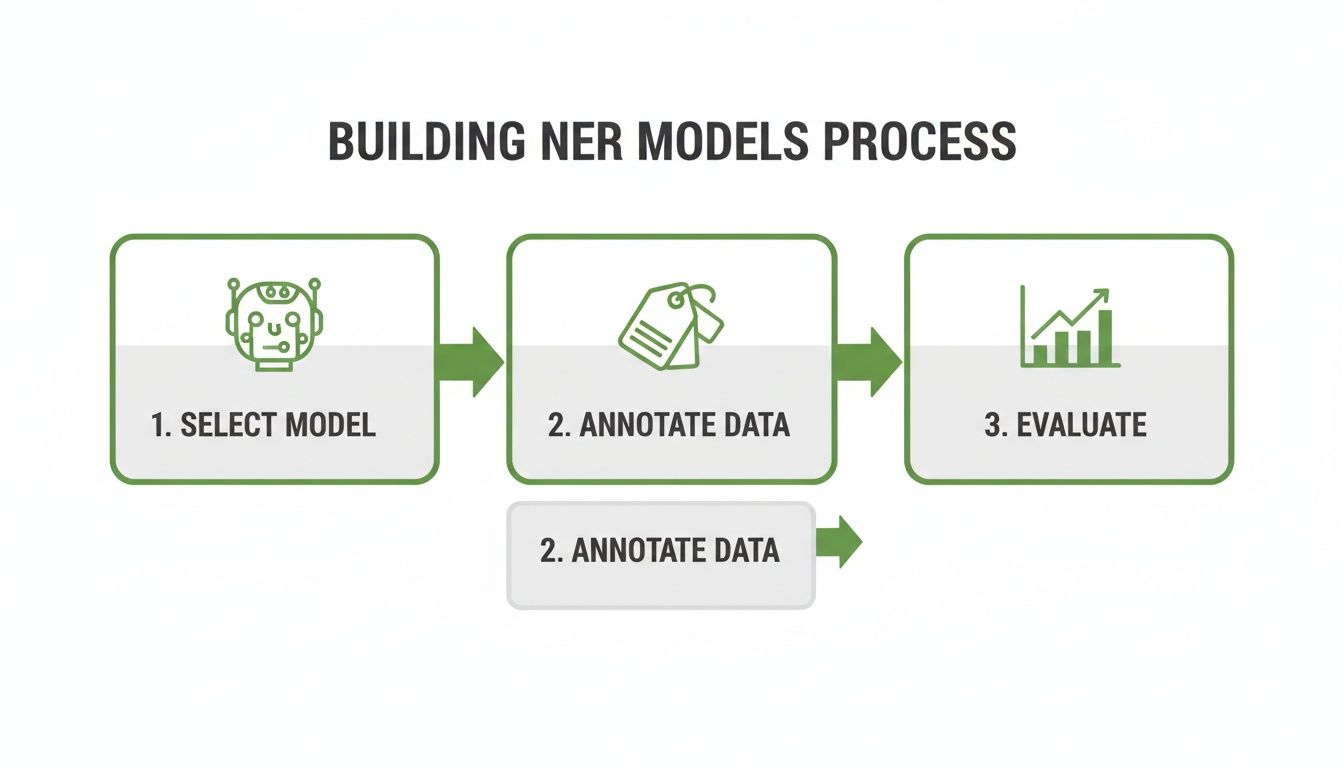
This workflow is the foundation for creating custom NER models that can spot the unique entities that matter to your business, which in turn fuels the whole entity-aware chunking process.
A Practical Example with ChunkForge
Let's say you're processing a monster of an annual financial report. It's packed with critical entities: product names (X-100 Series), competitor names (Global Tech Inc.), and key financial figures ($50M revenue). A standard fixed-size chunker would almost certainly butcher sentences and paragraphs containing this information, destroying context.
This is where a purpose-built tool like ChunkForge comes in. It gives you a visual way to not only test different chunking strategies but also to enrich the resulting chunks with metadata from an NLP named entity recognition model.
By running an NER model over the financial report inside ChunkForge, you can automatically tag each chunk with a JSON object like
{"product": "X-100 Series", "company": "Global Tech Inc."}. This rich metadata is then indexed right alongside the chunk's semantic vector in your vector database.
This prep work pays off big time when it's time to retrieve information.
When a user asks, "How did the X-100 Series perform against Global Tech Inc.?", your RAG system can now run a powerful hybrid query. It performs a semantic search for the question while also applying a strict metadata filter to only look at chunks where product == "X-100 Series" AND company == "Global Tech Inc.".
This dual approach guarantees that the LLM receives only the most relevant, factually-grounded information. It slashes the risk of retrieving vague or unrelated content, leading to answers that are more accurate, reliable, and trustworthy.
For a deeper look into these methods, check out our complete guide to chunking strategies for RAG, which gets into the nitty-gritty of how different approaches handle complex documents. By combining smart chunking with rich entity metadata, you build a RAG system that operates with precision, not just probability.
Supercharging RAG Retrieval with Entity-Enriched Metadata
Once your documents are processed and the chunks are enriched with entity metadata, you unlock a new level of retrieval precision in your RAG system. This isn't a minor tweak; it's a fundamental upgrade that transforms retrieval from a fuzzy semantic search into a sharp, fact-driven operation.
This shift is precisely what separates a cool RAG demo from a reliable, enterprise-grade AI system. You're no longer just hoping the right context gets pulled. Instead, you can command your system to find specific information with surgical accuracy. The result? More relevant, trustworthy, and auditable responses from your LLM.

Advanced Retrieval Patterns with NER
With structured metadata attached to each chunk, you can implement advanced retrieval patterns that are impossible for vector search alone. These methods give you the best of both worlds: deep semantic understanding combined with structured, logical filtering.
-
Hybrid Search: This is the most immediate win. Your retrieval logic should parse the user's query to extract entities and use them as metadata filters alongside the semantic search. For a question like, "Show me financial reports about 'Project Phoenix' from Q3 2023," the system does a semantic search while also strictly filtering for chunks where
project: 'Project Phoenix'anddate_range: 'Q3 2023'. It’s simple, powerful, and incredibly effective at reducing noise. -
Knowledge Graph Construction: You can use an NER model to extract entities and their relationships, building a knowledge graph from your documents. This opens the door to complex, multi-hop questions. For example, "Which engineers worked on the same project as Sarah Jones?" can be answered by traversing the graph—a feat impossible for a standard RAG setup.
-
Faceted Search: This pattern empowers users to slice and dice their search results. After an initial query, the system can display a list of all entities found in the results (like authors, companies, or locations). Users can then click on these "facets" to drill down and narrow the context, putting them in control of the information discovery process.
Driving Business Value and System Transparency
Implementing NLP named entity recognition in your RAG pipeline doesn't just make it more accurate—it makes the whole system more transparent and easier to debug. When a chunk is retrieved, engineers can see exactly why: it matched the semantic query and the specific metadata filters. This audit trail is critical for building trust and diagnosing failures in production systems. For some great real-world examples of this in action, check out illumichat's practical NER and RAG use cases.
With 80–90% of all enterprise data being unstructured text, NER is the key that unlocks its value for RAG systems. The Natural Language Processing (NLP) market is projected to skyrocket from $18.9 billion in 2023 to $68.1 billion by 2028, a massive signal that entity-aware retrieval is now a core competency. You can learn more about the NLP market's explosive growth in this detailed report.
Ultimately, integrating structured entity data is about adding guardrails to your RAG system. It constrains the retrieval process to factually relevant information, which in turn grounds the LLM's responses in verifiable data, reducing hallucinations and boosting user confidence.
Common Questions About Using NER in RAG
When you start weaving Named Entity Recognition into a RAG pipeline, a few practical questions always pop up. It's one thing to understand the theory, but getting the implementation right is what separates a decent system from a great one. Let's tackle the common hurdles engineers face when putting NER to work in the real world.
Getting these details right is how you build a RAG system that delivers sharp, reliable answers instead of just "good enough" ones.
How Do I Handle Custom Entities That Aren't in Pre-Trained Models?
This is the most common—and most important—question for improving retrieval. The answer is fine-tuning a pre-trained model. This is the key to unlocking domain-specific value from your documents.
Start by creating a labeled dataset where your unique entities are clearly marked. Think internal project codes (PROJECT-X7B), proprietary chemical formulas, or specific legal clauses that off-the-shelf models would never recognize.
From there, you can use a framework like spaCy or Hugging Face Transformers to teach a base model this new knowledge. You don't need a massive dataset to get started; often, a few hundred high-quality, consistently annotated examples can produce a noticeable lift. The absolute key is creating clear annotation guidelines so every label means the same thing, every time.
For a RAG pipeline, even a moderately accurate custom NER model is a massive win. It gives your retrieval system a powerful new filter that's infinitely better than having no specific entity knowledge at all.
What’s the Performance Hit from Running NER on All My Documents?
It's true that NER adds a computational step, but the cost is manageable and front-loaded. NER is a one-time preprocessing step you perform during data ingestion, not every time a user asks a question. All the heavy lifting is done upfront.
To make this process efficient, you have a couple of good options:
- Use distilled models: Lighter-weight models like
distilBERTare fantastic. They offer a great balance, giving you most of the accuracy of their larger siblings at a fraction of the computational cost and are ideal for preprocessing large document sets. - Lean on your hardware: If you have access to a GPU, use it. Processing documents in batches on a GPU can be orders of magnitude faster than running them one-by-one on a CPU.
The boost in retrieval accuracy and reduction in LLM workload almost always justifies the initial processing cost.
Think of it this way: investing compute upfront to extract entities makes your retrieval process exponentially more efficient. This preprocessing isn't an expense; it's a direct investment in the accuracy and trustworthiness of your final RAG output.
Can NER Actually Help Reduce Hallucinations in My RAG System?
Yes, absolutely. It's an indirect but incredibly powerful fix. Hallucinations in RAG are usually a symptom of poor retrieval. When the LLM gets irrelevant, conflicting, or incomplete context, it’s forced to improvise and fill in the gaps.
NER tackles this at the source by making retrieval surgically precise.
Imagine a user asks, "What were the Q3 results for Project Apollo?" With entity-enriched chunks, a hybrid search can instantly filter the knowledge base for any text tagged with PROJECT: Project Apollo and DATE: Q3. This ensures the LLM receives only the most relevant, factually grounded documents to work with.
This level of precision forces the LLM to stick to the facts presented in the retrieved documents. By cutting out the noisy, adjacent-but-wrong information, you dramatically slash the odds of the model inventing details.
Should I Use a Commercial NER API or Build My Own Model?
This decision boils down to your need for customization, data privacy, and budget.
Commercial APIs from providers like Google Cloud Natural Language AI or Amazon Comprehend are incredibly easy to plug in. They work great for standard entities like people and places. The trade-offs? They can get pricey at scale, require sending your data to a third party, and will struggle to recognize the unique, domain-specific entities that often provide the most retrieval value.
Building your own model using open-source libraries gives you total control. Your data stays in-house, you can tune the model to perfectly recognize your proprietary terms, and you aren't locked into a vendor's pricing model. For most production RAG systems built on private company data, this is the superior path as it delivers the highest accuracy on the entities that are core to your business.
Ready to build entity-aware RAG pipelines with precision and control? ChunkForge provides a complete visual studio for chunking documents, enriching them with custom metadata, and preparing them for any vector database. Start your free trial today and turn your raw documents into retrieval-ready assets. Explore ChunkForge.