Named Entity Recognition NLP: A Guide To Supercharging RAG Systems
Discover how named entity recognition NLP transforms RAG systems. This guide offers actionable strategies for better document chunking and metadata enrichment.
Named Entity Recognition (NLP) is a fancy term for a simple, powerful idea: automatically finding and classifying key pieces of information in text. Think of it as a digital highlighter that knows the difference between a person, a company, and a place. For Retrieval-Augmented Generation (RAG), this process is foundational. It transforms messy, unstructured sentences into neat, structured data points—an essential step for enabling precise and reliable information retrieval.
Why Named Entity Recognition Is a Game Changer for RAG

Imagine trying to find a specific fact in a library with millions of books but no card catalog. You'd be lost. That’s exactly the challenge Retrieval-Augmented Generation (RAG) systems face when swimming in vast pools of unstructured data. Named Entity Recognition (NER) acts as that intelligent cataloger, enabling highly accurate retrieval.
Instead of just seeing a wall of words, your system can spot 'Apple Inc.' and know it's a company, or see 'Tim Cook' and identify him as a person. This is the critical first move in turning raw text into organized, searchable knowledge that a RAG system can use to find the right context before generation.
From Raw Text to Actionable Retrieval Signals
At its core, NER lets a RAG system figure out the who, what, where, and when hiding inside a document. This is fundamental to improving how information is retrieved and used, and the benefits for RAG are immediate.
Here’s how NER integration directly supercharges the retrieval phase of a RAG pipeline:
- Precision Retrieval: Forget vague keyword searches. You can now design queries that ask for documents mentioning "Project Gemini" (an event) and instantly filter out those that only talk about "Gemini" (a zodiac sign). This moves retrieval from a probabilistic guess to a targeted query.
- Contextual Understanding: By recognizing entities, the retrieval system starts to grasp the relationships between concepts in the text. This deeper understanding is vital for piecing together accurate, relevant context for the LLM, instead of just passing along isolated facts.
- Structured Metadata Creation: Extracted entities become metadata tags. Suddenly, your chaotic folder of documents transforms into a structured, navigable database, enabling powerful filtered search capabilities that improve retrieval speed and relevance.
The core value of NER for RAG is its ability to create structure from chaos. It doesn't just find words; it identifies and categorizes concepts, giving your RAG system the hooks it needs to retrieve the right information at the right time.
This tech has come a long way. Early systems in the 1990s were rule-based, hitting F1 accuracy scores in the 60-80% range—not bad, but not great. Today, modern Transformer-based models routinely blow past 90% on English datasets.
This leap in performance has had a massive real-world impact, with some companies reporting workload reductions between 30% and 70% in manual review tasks like compliance checks and customer support.
For RAG systems, this isn't just a minor tweak. It's the bedrock for retrieving highly accurate, contextually relevant information. That directly translates to better, more reliable AI-generated answers, a topic we dive into in our guide to retrieval-augmented generation.
The Journey From Simple Rules To Smart Transformers
Understanding how machines got so good at Named Entity Recognition (NER) is a bit like watching a craftsman's toolkit evolve. We started with simple hand tools and eventually built sophisticated, intelligent machines. Each new method was a leap forward, solving problems its predecessor couldn't touch.
The whole field of Named Entity Recognition NLP started with the most straightforward approach you can imagine: writing a bunch of rules.
Starting With Handcrafted Rules
The very first NER systems were built on a simple premise: if you can describe a pattern, you can find it. These rule-based systems use handcrafted instructions—usually a mix of regular expressions and massive dictionaries—to pinpoint entities.
Think of it as a super-powered "Find and Replace." To find a date, you’d write a rule that looks for a specific format like DD-MM-YYYY. To find a company, you might just feed the system a dictionary of thousands of known company names.
This approach is wonderfully transparent and quick to get started with for highly predictable text. But it's also incredibly brittle. A rule designed for DD-MM-YYYY will completely miss "January 5th, 2023." It also trips up on ambiguity. Your dictionary might list "Apple," but it has no way of telling the fruit from the tech giant without more clues. Keeping these rulebooks up-to-date for complex tasks becomes a manual, never-ending chore.
Learning From Examples With Classical Machine Learning
Once the cracks in rule-based systems started to show, the field shifted to a new way of thinking: what if a machine could learn the patterns for itself? This shift gave rise to classical machine learning models, with Conditional Random Fields (CRF) being a prime example.
Instead of being fed rigid instructions, these models are trained on huge datasets of pre-labeled text. It’s like showing a student thousands of sentences where all the names, places, and organizations are already highlighted. Over time, the student starts to pick up on the statistical patterns surrounding each type of entity.
For instance, a CRF model might learn that a capitalized word following "Mr." is almost certainly a person's name, or that a word ending in "Inc." is probably an organization. This was a huge step up. These models could generalize to new, unseen examples far better than rigid rules ever could. They learned to weigh different contextual clues to make a decision—a major move from pure instruction to real inference.
Understanding Context With Transformers
The most recent and powerful chapter in the NER story belongs to Transformer-based models, like the famous BERT and its many successors. These models don't just look at the words immediately next to a potential entity; they understand the context of the entire sentence and even the whole document.
Let's go back to that "Apple" problem. A Transformer model processes the full sentence:
- "He ate a red apple for lunch."
- "He bought a new Apple laptop."
The model analyzes the web of relationships between all the words. It learns that words like "ate" and "red" hang out with the fruit, while "laptop" and "bought" are buddies with the tech company. This ability to grasp deep, nuanced context is what makes Transformers so powerful. They deliver state-of-the-art performance because they understand language in a way that just wasn't possible before.
Transformer models fundamentally changed NER by shifting the focus from recognizing patterns to comprehending context. This is why they are the go-to choice today for building robust NER systems that can handle the ambiguity of human language.
To make this more concrete, here’s a quick look at how a modern NLP library like spaCy puts these ideas into practice, identifying and labeling different entities on the fly.
You can see the model correctly tags "Apple" as an organization, "U.K." as a geopolitical entity (GPE), and "$1 billion" as money. It's a perfect illustration of how these advanced techniques work in the real world.
The journey from simple rules to context-aware Transformers shows a clear and logical progression. Each step built upon the last, moving from rigid instructions to statistical learning and, finally, to a deep, contextual understanding of language.
To help you decide which approach fits your needs, let's break down the core differences.
Comparison of NER Methodologies
This table compares the different NER methods, highlighting their core principles, best use cases, and limitations. It's a quick guide to help you match the right tool to the job.
| Methodology | Core Principle | Best For | Key Limitation |
|---|---|---|---|
| Rule-Based | Uses handcrafted patterns (e.g., regex, dictionaries) to find exact matches. | Simple, highly predictable text formats like dates, emails, or product codes. | Brittle and inflexible; fails on new or varied patterns and struggles with ambiguity. |
| CRF | Learns statistical patterns from labeled data to predict entity sequences. | Structured text where local context (e.g., surrounding words) is a strong signal. | Limited by the "window" of context it sees; can't grasp long-range dependencies. |
| Transformer | Models the contextual relationships between all words in a sequence to understand meaning. | Complex, ambiguous language where deep context is needed to make correct decisions. | Computationally intensive and requires large datasets for training from scratch. |
Ultimately, while older methods still have their place for specific tasks, anyone building a modern RAG system should be looking at Transformers. Leveraging Transformer-based NER is the key to unlocking the kind of precise, reliable information retrieval that today's applications demand.
Two Ways NER Revolutionizes RAG Retrieval
Once you have a handle on what Named Entity Recognition (NER) is, the next logical step is putting it to work. For Retrieval-Augmented Generation (RAG) systems, just spotting entities isn’t the finish line—it’s the starting gun for a much smarter, more precise retrieval process.
Let's break down two powerful, actionable strategies that use NER to directly upgrade the quality of information your language model sees, leading to far more accurate and trustworthy answers.
Turning Unstructured Text Into A Structured Database
The first and most powerful use of NER is for metadata enrichment. Think of your document library as a warehouse full of unlabeled boxes. Vector search is like a metal detector; it's great at finding boxes with a similar magnetic signature (semantic similarity), but it can't find a specific object by name.
NER is your automated labeling machine. It zips through each document, identifies the key items inside, and slaps clear, descriptive labels on the outside.
This simple act transforms your messy, unstructured text into a highly organized, queryable database. When you run an NER model over your content, you pull out concrete entities like:
- Project Gemini (PROJECT)
- Dr. Anya Sharma (PERSON)
- Q4 2023 (DATE)
- Stryker Corporation (ORGANIZATION)
These extracted entities become searchable metadata tags attached to each document chunk. This unlocks a potent hybrid search capability. Instead of leaning entirely on the fuzzy art of semantic similarity, you can now run surgically precise, filtered queries.
By converting entities into structured metadata, you give your RAG system the ability to filter information with the precision of a database. You’re moving from probabilistic retrieval, which thinks a document is relevant, to deterministic retrieval, which knows it is.
For example, a query like, "What were the Q4 2023 financial results for Stryker Corporation?" can now be handled much more intelligently. The system can first execute a filtered search for all chunks tagged with ORGANIZATION: Stryker Corporation and DATE: Q4 2023. This move drastically narrows the search field, ensuring vector search only has to work on the most relevant content. The result? Fewer junk documents and a much higher chance of finding the exact context needed.
The journey from old-school rule-based systems to modern Transformer models is what makes this level of metadata enrichment a reality. The visual below shows how NER technology has progressed over the years.
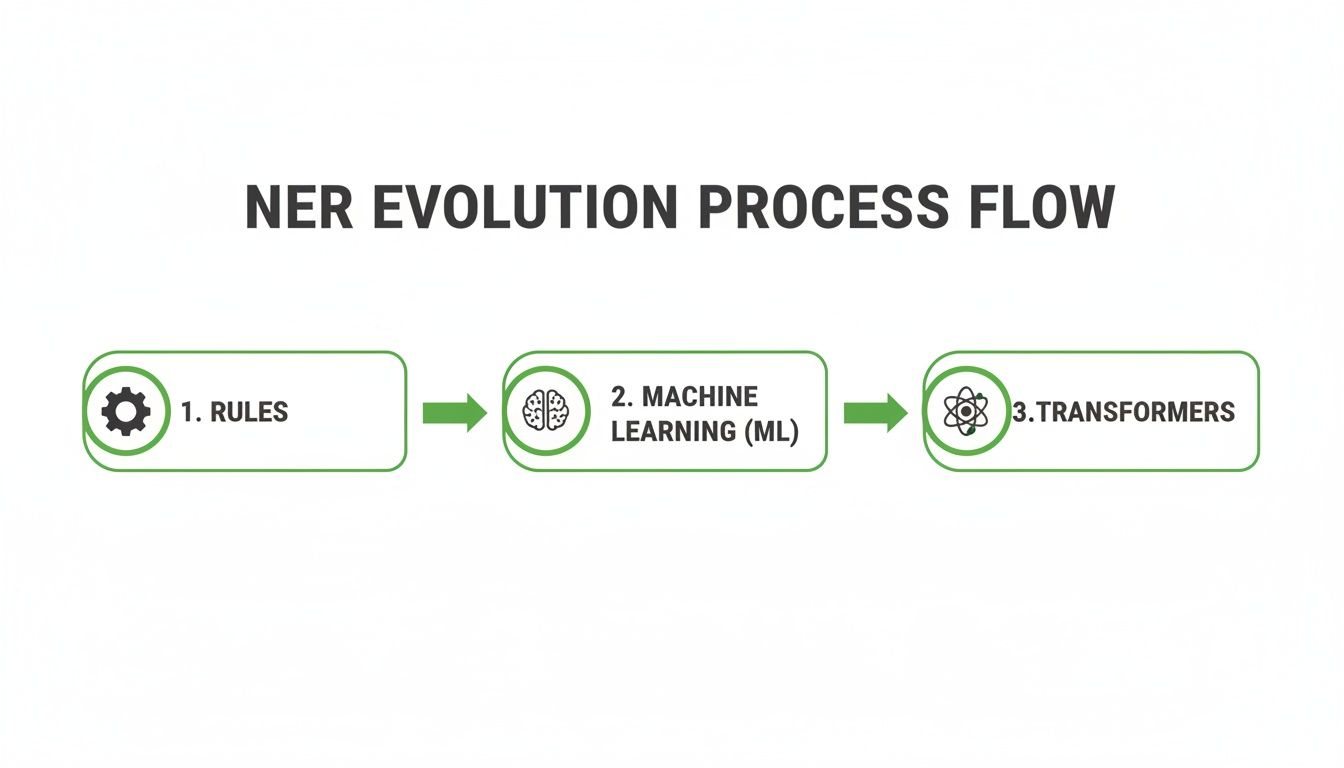
This evolution from rigid rules to adaptive machine learning and finally to context-aware Transformers has enabled more accurate and nuanced entity extraction for creating better metadata. These enriched tags can even be used to build a knowledge graph, offering an even more powerful way to connect the dots between entities. For a deeper dive, check out our guide on combining knowledge graphs with RAG.
Building Smarter Chunks With Intelligent Chunking
The second game-changing application for NER is intelligent chunking. Standard chunking methods—like splitting a document every 1,000 characters or by paragraph—are blunt instruments. They often slice right through important context, separating a key idea from its explanation.
It's like tearing a newspaper article in half. You might get the headline in one piece and the critical facts in another, leaving your RAG system with a confusing, incomplete puzzle. This directly leads to lower-quality answers because the retrieved context is fragmented.
Intelligent chunking uses entities as guideposts to create contextually whole chunks. Instead of splitting text based on arbitrary lengths, this approach uses entities to signal where a complete thought begins or ends. The entire goal is to keep related information together.
Here are a few actionable insights for implementation:
- Entity-Centric Windows: Build a chunk around every important entity. For instance, for every mention of "Project Gemini," you could grab the 200 words before and after it, guaranteeing the project’s full context is captured.
- Section-Aware Splitting: Use headings and subheadings as natural boundaries. This respects the document's original structure, keeping all the information under a specific topic in one piece.
- Entity Density Analysis: Look for areas with a low density of named entities and split there. A paragraph with few or no entities is often transitional text, making it a much safer place to create a boundary without breaking up a key concept.
Imagine you're analyzing a project report. A fixed-size chunker might split a sentence like, "The final budget for Project Gemini was approved by Dr. Anya Sharma," separating the project from the person. An entity-aware chunker, on the other hand, would recognize both entities and work to keep them in the same chunk, preserving that crucial relationship.
By adopting these NER strategies, you feed your language model higher-quality, context-rich information. That translates directly into more accurate, relevant, and trustworthy answers from your RAG system.
Putting Theory Into Practice With Python
Alright, enough theory. This is where the magic happens—turning concepts into code. Getting a named entity recognition nlp model running in Python is surprisingly simple, thanks to incredible open-source libraries like spaCy and Hugging Face Transformers. These toolkits hand you pre-trained models that can start pulling entities out of your text with just a few lines of code.
We're about to walk through a practical setup. I’ll show you how to load a model, feed it some text, and—most importantly—structure the output so it’s actually useful for a RAG pipeline. The goal isn’t just to spot entities; it's to make them immediately ready for metadata enrichment and smarter document chunking.
Getting Started with spaCy
spaCy is a crowd favorite for a reason. It's built for production: fast, user-friendly, and incredibly efficient. If you need performance without a ton of complexity, this is your starting point.
Pulling entities from a document is a quick, three-step dance.
First, install the library and grab a pre-trained model. We'll use en_core_web_sm—it's a small, nimble English model that's perfect for getting your feet wet.
Install spaCy and download a model
!pip install spacy !python -m spacy download en_core_web_sm
Next, you load that model and pass your text through it. This creates a special Doc object, which is basically a container holding your text along with all the linguistic goodies spaCy found, including our named entities.
import spacy
Load the pre-trained English model
nlp = spacy.load("en_core_web_sm")
Your text to be processed
text = """ Apple Inc. announced a new partnership with a European firm, ACME Corp, on December 15th, 2023. The deal, valued at $2.5 billion, was finalized in Berlin by CEO Tim Cook. """
Process the text with the spaCy pipeline
doc = nlp(text)
Iterate over the detected entities
for ent in doc.ents: print(f"Text: {ent.text}, Label: {ent.label_}")
Run this script, and you’ll see each entity's text printed alongside its label (ORG for organization, DATE for a date, etc.). It’s a clean, effective way to see NER working in seconds.
Processing NER Output for RAG Pipelines
Just printing entities to the console is cool, but it doesn't help our RAG system. For that, we need to convert the output into a structured format like JSON. This clean data can be fed into a metadata store or used by a custom chunking script, making your documents vastly more searchable.
Let's tweak our script to produce a nice JSON output.
import json
... (previous spaCy setup code) ...
doc = nlp(text)
Convert entities to a list of dictionaries
entities_list = [ {"text": ent.text, "label": ent.label_} for ent in doc.ents ]
Create a final JSON object
json_output = { "original_text": text, "entities": entities_list }
Print the structured JSON output
print(json.dumps(json_output, indent=2))
Now that's useful. This structured output can be attached directly to your document chunks, unlocking the powerful filtered searches we talked about earlier. Of course, before you can process any documents, you need to get the text out. If you're dealing with PDFs, check out our guide on Python PDF text extraction to get your content ready for the pipeline.
Choosing The Right Pre-Trained Model
The model you pick directly impacts your RAG system's performance. It’s almost always a balancing act between three factors.
The best model for your project depends on your specific needs. There's no one-size-fits-all answer, only a series of trade-offs between speed, accuracy, and complexity.
Here’s a simple way to think about it:
- Need for Speed? For real-time applications where every millisecond counts, go with a smaller model like spaCy's
en_core_web_sm. It’s optimized for CPU and gives you great performance with solid accuracy. - Accuracy is Everything? If precision is non-negotiable, you’ll want to look at larger models from Hugging Face, like those based on BERT or RoBERTa. They are resource-hungry but deliver state-of-the-art results by understanding complex context.
- Working with Jargon? A generic model will stumble over specialized text like legal contracts or medical research. Here, you'll need to either fine-tune a model on your own data or find one already trained for your domain (like BioBERT for biomedical text).
By starting with a simple implementation and a clear idea of your end goal, you can weave named entity recognition into your RAG workflow and give its retrieval powers a serious boost.
Solving Real-World NER Implementation Challenges
<iframe width="100%" style="aspect-ratio: 16 / 9;" src="https://www.youtube.com/embed/ujubwa_oa-0" frameborder="0" allow="autoplay; encrypted-media" allowfullscreen></iframe>Getting a named entity recognition nlp model out of a Jupyter notebook and into the real world is where the real work begins. It’s a classic trap: a model performs beautifully on clean training data, but the moment it sees messy, specialized documents, its accuracy falls off a cliff.
Think about it. A standard NER model trained on news articles will happily tag "Apple Inc." and "Berlin." But ask it to parse a legal contract or a medical chart, and it will completely miss domain-specific entities like "indemnity clause" or "myocardial infarction." This isn't a small gap; it's a chasm that directly impacts retrieval quality.
The reality is that every new domain introduces new vocabulary and context, causing a quantifiable drop in performance. While a model might hit a 90% F1 score on English news, you can expect that to drop by 10 to 40 F1 points when you deploy it in the wild.
The good news? The fix is well-understood. Studies show that fine-tuning with even a few thousand labeled examples can boost F1 scores by 10–25 percentage points in complex fields like biomedical research. But this adaptation comes at a cost, often eating up 20–50% of the initial deployment budget. For a deeper dive into these numbers, you can explore the research on NLP market performance.
Closing The Accuracy Gap With Fine-Tuning
The most reliable way to bridge this performance gap is fine-tuning. You take a powerful, pre-trained model and simply continue its training, but this time using a small, high-quality dataset of your own documents. This process teaches the model your specific language and context.
Here’s a practical playbook to get started:
- Write Clear Annotation Rules: Before anyone labels a single word, create a detailed guide. Define every custom entity with clear examples of what to tag and what to ignore. Consistency is everything.
- Build a "Golden" Dataset: Start by annotating a few hundred documents that represent your typical data. This "golden set" becomes your ground truth for measuring model performance.
- Iterate and Improve: Fine-tune your model on this dataset and check its F1-score, precision, and recall. Dig into its mistakes. Are they random, or is there a pattern? Use these insights to update your guidelines and label more data.
Tackling Ambiguity and Low-Resource Languages
Another common headache is entity ambiguity. How does a model know "Stryker" is a medical device company and not a person's name? The answer is context. While modern models are pretty good at this, you might need to fine-tune with specific examples that clarify these distinctions in your domain.
The challenge gets even tougher for languages with fewer training resources. Pre-trained multilingual models are a solid starting point, but they rarely perform as well as their English-first counterparts.
To build an NER pipeline that is both powerful and reliable, you have to build a human-in-the-loop system. This means creating a workflow where a human expert reviews and corrects the model’s predictions. Those corrections then get fed back into the training data, creating a virtuous cycle of continuous improvement.
This iterative loop of fine-tuning, evaluating, and correcting is how you build a production-ready NER system. It’s the only way to get the high-quality metadata your RAG pipeline needs to truly shine.
The Business Case For Investing In NER
Let's be honest: justifying a technical investment like named entity recognition nlp comes down to tangible business value. For RAG systems, NER isn't just a clever algorithm; it’s a strategic asset that brings order to the chaos of unstructured data, enabling higher-quality, more reliable AI outputs.
The ROI snaps into focus when you see how precise entity extraction drives efficiency, unlocks insights, and improves retrieval accuracy. Companies are already using NER to automate mind-numbing data entry, supercharge risk monitoring systems, and make sense of millions of customer reviews. By converting raw text into clean, structured data, they’re building the foundation for smarter, faster operations.
Market Growth And Strategic Value
Putting money into NER isn't about keeping up—it's about getting ahead. Market forecasts make it crystal clear that NER is a core engine in the booming NLP landscape.
For example, the global Natural Language Understanding market is on a rocket ship, projected to grow from $23.7 billion in 2024 to a massive $439.1 billion by 2034. NER is consistently cited as a key driver of that growth. With North American markets grabbing nearly a 49% share, it’s obvious that this technology is central to commercial AI adoption. You can dig into these market growth projections for more detail.
Investing in a robust NER strategy is no longer a forward-thinking experiment. It’s a foundational requirement for any organization that's serious about its data. The technology translates directly into measurable gains in operational speed, data accuracy, and business intelligence.
This economic momentum is spilling over into adjacent markets, too. The AI data annotation market—which is absolutely essential for training high-quality NER models—is also set to expand significantly. This is a strong signal that serious investment is flowing not just into the models themselves, but into the entire data pipeline required to make them actually work in the real world.
Common Questions About NER For RAG
When you start weaving named entity recognition into a RAG system, a few practical questions always pop up. Let's walk through the common sticking points and how to think about them.
How Do I Choose Between Metadata Filtering And Intelligent Chunking?
This is a classic "why not both?" scenario. They solve different parts of the retrieval puzzle and are incredibly powerful when used together.
Think of it this way: metadata enrichment is your first-pass filter. Tagging documents with entities lets you implement filtered search, which dramatically narrows the search space before vector similarity is even calculated. It's often the easier of the two to get up and running.
Intelligent chunking is the next layer of refinement. It focuses on the quality of the context you actually retrieve, ensuring each chunk makes sense on its own. The best approach uses metadata to find the right documents, then intelligent chunking to pull the perfect, most coherent context from them.
What Is The Biggest Mistake When Fine-Tuning An NER Model?
By far, the single biggest mistake is inconsistent annotation. It's a silent killer for model performance.
If one person on your team labels "ABC Corp." as an ORGANIZATION but another tags it as something else—or misses it entirely—your model gets conflicting signals. It's like trying to teach a child two different names for the same object. This inconsistency directly harms the quality of the metadata your RAG system relies on for retrieval.
Before a single document gets labeled, create a crystal-clear annotation guide. Everyone involved must follow it to the letter. Consistency in your training data is far more important than the sheer volume of it.
Use tools that can enforce your guidelines and run regular quality checks to catch any drift.
Can A Generic Pre-Trained Model Work For RAG?
It completely depends on your documents. If you're working with general-purpose content like news articles, a solid pre-trained model from spaCy or Hugging Face can work wonders right out of the box for common entities like people, places, and companies.
But the moment you step into a specialized field—think legal contracts, clinical trial data, or dense financial reports—a generic model will start missing the entities that actually matter. It doesn't know what a "syndicated loan agreement" or a "caspase-3 inhibitor" is. If your retrieval depends on these specific terms, the generic model will fail you.
For any domain-specific content, you should absolutely plan to fine-tune a model on your own data. It's the only way to get the kind of retrieval accuracy a production-grade RAG system needs.
Ready to move from theory to production? ChunkForge provides the tools you need to apply these advanced NER strategies today. Convert your documents into perfectly structured, RAG-ready chunks with powerful metadata enrichment and multiple intelligent chunking options. Start your free trial at https://chunkforge.com.