A Guide to Intelligent Document Processing for Advanced RAG
Elevate your RAG systems with intelligent document processing. Learn actionable strategies for advanced chunking, metadata enrichment, and evaluation pipelines.
Intelligent document processing (IDP) is the critical first step in transforming your raw, unstructured documents into clean, structured data optimized for retrieval. For anyone building a high-performing Retrieval Augmented Generation (RAG) system, mastering IDP isn't just a best practice; it's the foundation for enabling precise, context-aware information retrieval that allows your AI to deliver accurate answers.
Why RAG Retrieval Performance Hinges on Intelligent Document Processing
Retrieval Augmented Generation holds incredible promise. It’s the key to letting AI reason over your private data and deliver answers with surgical precision. But there’s a catch, and it’s a big one: the quality of the information it retrieves. A RAG system is only as smart as the knowledge it can find.
Imagine you've hired a brilliant research assistant. If you give them a library full of disorganized books, with pages glued together and no table of contents, they’re going to fail. They’ll struggle to find anything useful and will probably give you a vague answer, a wrong one, or just give up. This is exactly what happens when you feed raw, unprocessed documents into your RAG pipeline.
The Problem with Unstructured Data for Retrieval
The reality for most organizations is that the overwhelming majority of their data—some estimates say over 80%—is unstructured. We’re talking about everything from dense legal contracts and financial reports to marketing PDFs and scanned invoices.
Just ripping the raw text out of these files and dumping it into a vector database is a recipe for disaster. It creates a mess of problems for your retrieval system:
- Lost Context: A single paragraph yanked from a 50-page legal agreement is meaningless without the surrounding clauses and section headers.
- Irrelevant Noise: Page numbers, headers, and footers get jumbled in with the actual content, polluting the search results and confusing the AI.
- Structural Blindness: The AI has no idea that a block of numbers is a critical financial table and not just a random list. It can't see the document's layout.
This is the classic "garbage in, garbage out" problem, and it’s the number one reason so many RAG projects fail to deliver accurate results. The retrieval step serves up low-quality, out-of-context junk, and the language model, in turn, generates unhelpful or flat-out wrong answers.
Intelligent Document Processing is the discipline of cleaning, organizing, and structuring your data before it ever gets to the retrieval system. It’s the foundational work that turns a chaotic, unusable library into a perfectly indexed and searchable knowledge base.
IDP as the Foundation for High-Fidelity Retrieval
This is where IDP steps in to directly improve retrieval. It acts as a sophisticated pre-processing engine that understands a document’s anatomy. It doesn't just see a wall of text; it sees titles, tables, lists, and paragraphs, and it understands how they all relate to one another.
IDP deconstructs each file, systematically extracts the important information, and structures it perfectly for retrieval.
By putting a solid IDP workflow at the front of your pipeline, you guarantee that the information flowing into your RAG system is clean, contextually rich, and ready for action. This isn't just a "best practice"—it's the single most important factor that separates a RAG system that gives frustratingly generic answers from one that delivers the precise, trustworthy intelligence your business depends on.
How an IDP Pipeline Deconstructs Documents for RAG
To get real value out of a document for Retrieval-Augmented Generation, you first have to break it down. Think of an Intelligent Document Processing (IDP) pipeline as a sophisticated reverse assembly line. Instead of building something, it carefully takes complex documents apart, turning a messy jumble of text, tables, and images into a structured, AI-friendly format.
This process is the bedrock of high-performance retrieval. It makes sure the information you feed your RAG system isn't just a wall of text, but is rich with context, accurately labeled, and semantically organized. This structured intelligence is what enables the precise chunking and metadata enrichment that make accurate RAG possible.
The workflow below shows how intelligent document processing is the critical bridge that turns raw, messy documents into a clean knowledge base ready for an AI system like RAG.
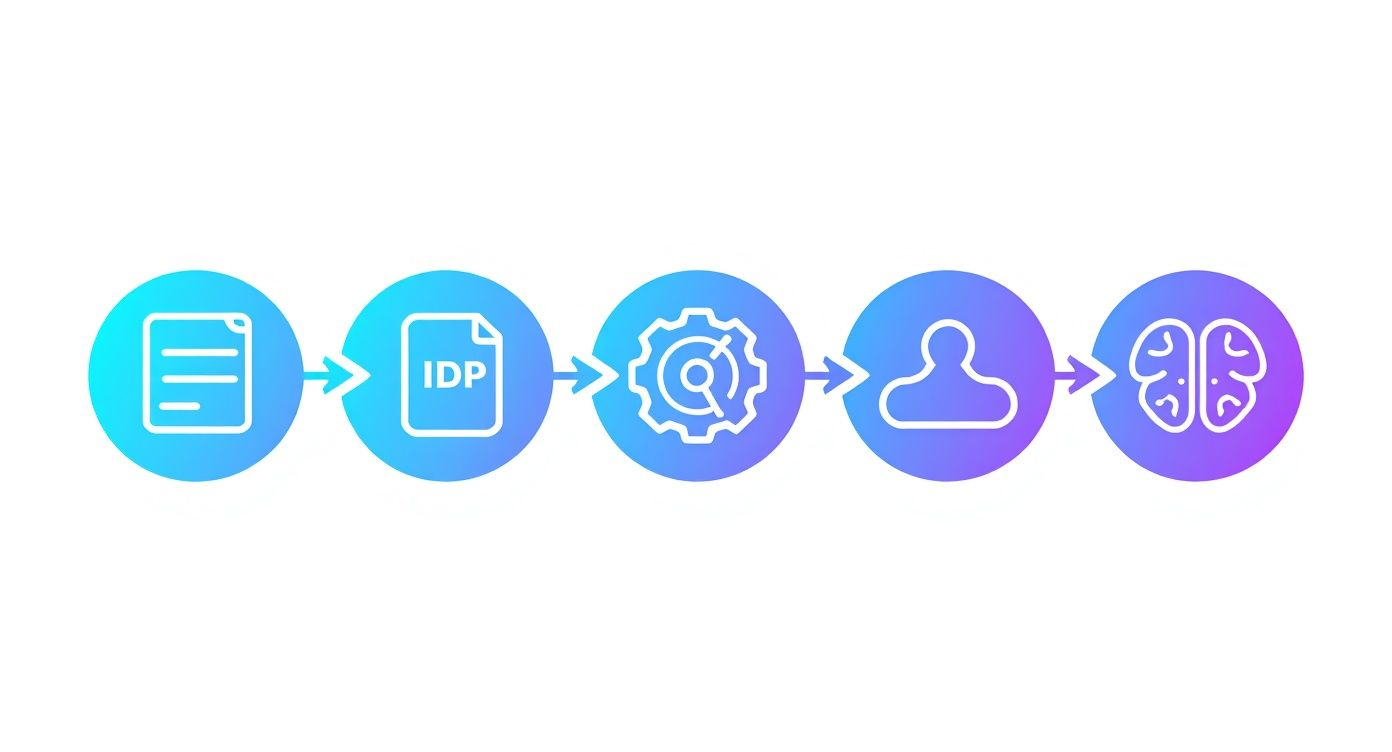
Ultimately, IDP isn't a single action. It’s a multi-stage transformation that prepares your content for a meaningful conversation with an AI.
The Initial Digitization Layer
The journey starts with Optical Character Recognition (OCR). This is the first, most basic step where the system turns scanned images or image-based PDFs into machine-readable text. Modern OCR engines are pretty good, but their output is still just a flat stream of characters.
While OCR is essential, it’s not nearly enough for RAG on its own. It gives you the raw material, but all the crucial context from the document's layout—things like tables, headings, and lists—gets completely lost. This is where the next layers of the IDP pipeline come in to add real value.
Structuring Content with AI-Powered Understanding
Once the text is digitized, the real intelligence kicks in. The pipeline moves through several advanced stages that build a semantic map of what the document is actually about.
Here are the core components that create this structure:
-
Document Classification: First, the system figures out what kind of document it's looking at. Is it an invoice? A legal contract? A lab report? This initial sorting is critical because it tells the pipeline what to look for next. For example, it knows to find line items in an invoice but to look for specific clauses in a legal agreement.
-
Layout Analysis: This step looks beyond the text to understand the visual structure. It identifies headings, paragraphs, lists, and—most importantly—tables. Recognizing a table as a structured grid of data, rather than a jumble of words and numbers, is absolutely vital for accurate extraction and retrieval.
-
Named Entity Recognition (NER): Think of NER as a set of digital highlighters. It automatically finds and tags key pieces of information like names, organizations, dates, and dollar amounts. Each tag adds a layer of metadata that makes searching far more precise.
-
Relationship Extraction: This stage connects the dots between the entities that NER found. It understands that "Jane Doe" is the "client" associated with "Contract #123," creating a web of relationships that preserves the document's original meaning.
The demand for this level of automation is off the charts. The intelligent document processing market was valued at around USD 3.0 billion in 2025 and is projected to explode to nearly USD 54.7 billion by 2035, growing at a compound annual rate of 33.4%. You can discover more about these market projections and their drivers.
An IDP pipeline doesn't just read a document; it comprehends it. It creates a rich, structured output where every piece of information is tagged, categorized, and interconnected, forming the ideal foundation for building a powerful RAG system.
By carefully deconstructing documents this way, IDP delivers the clean, organized, and context-aware data chunks that are essential for high-fidelity retrieval. This structured output is what enables advanced techniques like metadata filtering and semantic chunking. You can learn more about creating context-aware chunks in our guide to semantic chunking.
Choosing Your Architectural Blueprint for IDP and RAG
<iframe width="100%" style="aspect-ratio: 16 / 9;" src="https://www.youtube.com/embed/b-67km-wcEo" frameborder="0" allow="autoplay; encrypted-media" allowfullscreen></iframe>Connecting an intelligent document processing pipeline to a Retrieval Augmented Generation (RAG) system isn't a one-size-fits-all job. The architectural path you choose dictates how your knowledge base gets built and, more importantly, how it stays fresh. The decision really boils down to two core patterns: batch processing for the big initial lift, and streaming for keeping things current in real-time.
Think of it like building a library. The grand opening requires a massive, one-time effort to bring in thousands of books and get them on the shelves. That’s your batch processing. But after that, you need a system to add new books as they’re published, one by one, to keep the collection from getting stale. That’s streaming. You really need both for a library that’s both comprehensive and current.
Batch Processing for Initial Knowledge Base Creation
Batch processing is the heavy lifter, the workhorse you bring in to build the foundation of your RAG system. It’s perfect when you're sitting on a mountain of existing documents—think years of legal contracts, a massive archive of research papers, or a full library of product manuals. The goal is simple: process the entire collection in one big, scheduled operation.
The process itself is straightforward but incredibly powerful:
- Data Ingestion: First, you gather all your documents into a central spot, like an AWS S3 bucket or Azure Blob Storage.
- IDP Pipeline Execution: Next, a scheduled job kicks off, pushing the whole collection through your IDP pipeline. This is where the magic of OCR, classification, and data extraction happens.
- Vectorization and Indexing: Finally, the clean, structured data and metadata are transformed into vector embeddings and loaded into your vector database.
This architecture is ideal for creating a static knowledge base or for doing periodic, large-scale updates. Its biggest advantage is efficiency at scale. It lets you turn a huge, dormant archive into a living, searchable RAG asset in a predictable and manageable way.
The diagram below gives you a bird's-eye view of how this fits into a RAG architecture. The retriever is the component that fetches context from the knowledge base you just built.
This visual drives home just how critical the retriever is—it’s the bridge between a user’s question and your knowledge base. That's exactly why the quality of the information you index has to be top-notch.
Streaming Architecture for a Living Knowledge Base
If batch processing builds the library, a streaming architecture is what keeps it from gathering dust. This pattern is essential for any environment where new documents are constantly flowing in and need to be searchable almost immediately. Think of incoming customer support tickets, a steady stream of new invoices, or real-time intelligence reports.
A streaming architecture ensures your RAG system’s knowledge is never stale. It processes information as it arrives, providing users with the most current and accurate answers possible.
This real-time approach is built on an event-driven model. Instead of waiting for a scheduled job to run, the arrival of a single new document is the trigger that kicks off the whole process. Some of the key tech components you’ll often see are:
- Message Queues: Systems like Apache Kafka or AWS SQS act as a reliable front door, catching new documents and placing them in a queue for processing.
- Event-Driven Functions: Serverless functions, like AWS Lambda, are triggered the moment a new message appears in the queue. Each function is a tiny, dedicated worker that processes one document through the IDP pipeline.
- Real-Time Indexing: As soon as a document is processed, its new data chunk is immediately vectorized and added to the vector database, making it searchable within seconds or minutes.
So which path is right for you? It all comes down to your use case. Building an internal search engine over a historical archive? Start with a solid batch process. Creating a dynamic, customer-facing AI that needs to be up-to-the-minute? A streaming architecture is non-negotiable.
For a deeper look into how RAG works under the hood, you can learn more about Retrieval Augmented Generation in our comprehensive guide. Ultimately, most serious, production-grade systems end up using a hybrid approach: they run a massive batch job to lay the initial foundation and then switch on a streaming pipeline to keep that foundation perpetually up-to-date.
Actionable Techniques for RAG-Optimized Document Processing
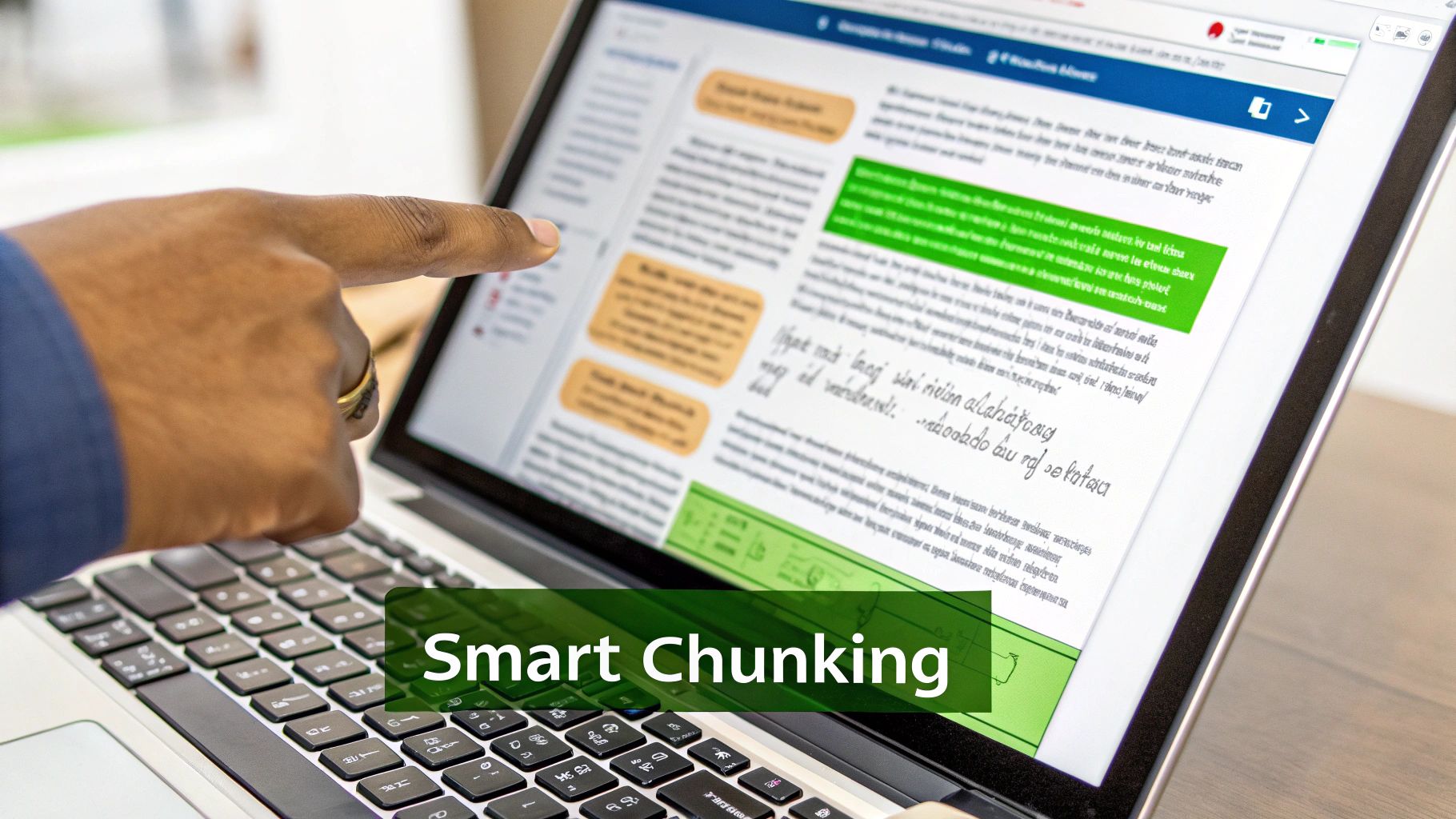
Once your IDP architecture is in place, the next step is to implement specific techniques that directly enhance retrieval quality. Effective intelligent document processing for RAG comes down to two actionable goals: creating highly contextual chunks and enriching them with descriptive metadata. These two practices are the most direct way to improve the performance and accuracy of your RAG system's retrieval component.
Master Advanced Document Chunking Strategies for Better Context
The single biggest mistake that degrades retrieval is using a naive, fixed-size chunking strategy. This approach is like taking a guillotine to your text, blindly chopping it into uniform pieces without any regard for sentences, paragraphs, or tables. It is the quickest way to destroy context and pollute your vector database with fragmented, useless information.
To build a high-performing retrieval system, you must adopt more intelligent chunking methods.
- Semantic Chunking: This technique analyzes the meaning of the text, grouping sentences and paragraphs based on topic. It identifies natural conceptual shifts and creates chunks that represent a complete thought. This results in coherent, self-contained units of information that are ideal for semantic search.
- Layout-Aware Chunking: For documents like financial reports or technical manuals, visual structure conveys critical meaning. Layout-aware chunking identifies and preserves elements like tables, lists, and headings as distinct units, ensuring that a table isn't fragmented across multiple chunks, which would render its data useless for retrieval.
Actionable Insight: The core principle for effective chunking is to align your splits with the document's logical and semantic boundaries. This ensures that every chunk indexed in your vector database is a meaningful, complete piece of knowledge, directly improving retrieval relevance.
By moving beyond fixed-size splits, you dramatically lower the chance of feeding your model confusing or incomplete information, which is a primary cause of poor RAG outputs.
Comparison of Document Chunking Strategies for RAG
| Chunking Strategy | Description | Pros | Cons | Best For |
|---|---|---|---|---|
| Fixed-Size Chunking | Splits text into chunks of a predefined character or token count. | Simple, fast, and predictable. Easy to implement. | Often breaks sentences and destroys semantic context. | Very uniform content like plain text logs or code where structure is minimal. |
| Paragraph/Sentence Splitting | Splits documents along natural linguistic boundaries like paragraphs or sentences. | Respects the author's original structure. Generally good context. | Paragraphs and sentences can vary wildly in size, leading to inconsistent chunks. | Well-structured articles, blogs, and documents with clear paragraphing. |
| Semantic Chunking | Uses embedding models to group semantically related sentences into a single chunk. | Creates highly coherent, context-rich chunks. Excellent for retrieval quality. | More computationally intensive and slower than simpler methods. | Complex technical documents, research papers, or any text with dense, interconnected concepts. |
| Layout-Aware Chunking | Identifies and separates structural elements like tables, lists, and headings. | Preserves the integrity of visual elements, crucial for data-heavy documents. | Can be complex to implement and may require custom parsers for specific layouts. | Financial reports, invoices, scientific papers, and technical manuals with tables and charts. |
Each strategy has its place, but for top-tier RAG performance, a combination of semantic and layout-aware chunking is often the winning ticket.
Enrich Chunks with Powerful Metadata for Precision Retrieval
Creating well-formed chunks is only half the battle. The other half is enriching them with metadata—descriptive tags that enable powerful filtering and sorting capabilities within your retrieval system. Think of metadata as a pre-retrieval filter; it allows your system to narrow down the search space before performing semantic similarity calculations.
Here's the kind of metadata you should be adding to every chunk to improve retrieval:
- Source Information: Include the document title, filename, author, and publication date. This lets you filter results by a document's origin.
- Structural Context: Tag the chunk's role in the original document, like
heading,table_cell, orlist_item. This gives the retrieval system vital clues about the information's format and importance. - Generated Summaries: Create a short summary for each chunk and attach it as metadata. This allows for a two-step retrieval process: first, search the concise summaries, then retrieve the full-text chunks for the top results. It's a great way to boost both speed and accuracy.
The need to implement these kinds of advanced techniques is a huge reason why IDP has taken off. By 2025, large companies already made up about 60% of the IDP market, driven by the need to handle complex document workflows. In North America alone, the market hit around USD 1.45 billion in 2025 and is expected to skyrocket to USD 19.98 billion by 2034. You can explore more market intelligence on the IDP industry for a deeper dive.
When you combine content-aware chunking with rich metadata, you build a rock-solid foundation for your RAG system. It ensures that when a user asks a question, your system doesn't just find a relevant piece of text—it finds the most relevant, contextually complete, and authoritative answer it has.
For anyone looking to put these ideas into practice, check out our guide to automate document processing for modern RAG applications.
Building Your RAG Evaluation and Improvement Loop
A high-performance RAG pipeline isn't just built; it's refined. The key to unlocking top-tier retrieval performance is creating a tight, continuous loop of evaluation and improvement. By systematically measuring retrieval accuracy, you can identify weaknesses and feed those insights back into your intelligent document processing workflow to make targeted fixes.
This approach turns a static tool into a dynamic asset that learns and evolves.
Establishing Your Evaluation Metrics for Retrieval
You can't improve what you don't measure. To diagnose retrieval issues, you need clear, quantitative metrics that focus specifically on the quality of the information your retriever finds.
Key metrics for evaluating retrieval quality include:
- Context Precision: Of the chunks that were retrieved, what percentage were actually relevant to answering the user's query? This measures how much noise your retriever is pulling in.
- Context Recall: Of all the relevant chunks available in the knowledge base, what percentage did the retriever successfully find? This measures whether your system is missing critical information.
- Hit Rate: A simpler metric: did the retrieved context contain the information needed to answer the question? A straightforward yes/no gives a clean baseline for success.
- Mean Reciprocal Rank (MRR): This metric rewards the system for ranking the most relevant document higher in the results list. High MRR is crucial for efficiency, as it means the language model gets the best information first.
Creating a Golden Evaluation Dataset
Metrics are only as good as the data you test them against. This is where your "golden dataset" comes in. It's a hand-curated set of question-and-answer pairs that mirrors the real-world queries you expect from users. Building this is one of the most important steps in creating your improvement loop.
Your dataset needs to be diverse and it needs to be tough. Make sure to include:
- Simple, factual questions to test basic retrieval.
- Complex queries that force the system to synthesize info from multiple chunks.
- Questions that specifically target tricky data, like numbers buried in financial tables or specific clauses in dense legal contracts.
Actionable Insight: Treat your golden dataset as the definitive benchmark for your RAG system. Use it to run automated evaluations every time you change your IDP workflow—whether you’re adjusting a chunking strategy or adding new metadata—to get objective proof of whether the change improved retrieval performance.
This dataset becomes the ground truth for all your automated tests. It spits out the metrics you need to see exactly where retrieval is breaking down, creating a repeatable process that tells you if your changes are helping or hurting.
Closing the Feedback Loop to Your IDP Pipeline
The insights you gather from your evaluations should directly drive improvements right back at the start of the process: your intelligent document processing workflow. This feedback loop is the engine that powers continuous retrieval improvement.
For example, if your evaluations show a low hit rate for questions about quarterly revenue, the problem is likely not the LLM but the retriever. This insight points you directly to a weakness in your IDP stage—perhaps your layout-aware chunking is failing to properly extract and preserve financial tables.
Armed with that knowledge, you can go back and fine-tune your table extraction logic. Once you've made the fix, you re-process the documents, update the vector index, and run the evaluation again. If your scores on table-related questions jump up, you've successfully closed the loop. This kind of targeted, data-driven work is how you systematically kill off weaknesses and build a truly robust, high-accuracy system.
This push for precision is exactly why market research shows that over 80% of enterprises plan on boosting their investments in document automation by 2025. The financial world is a great example, where 71% of companies in the Fortune 250 are already using IDP solutions. You can discover more insights about these document processing statistics and see what's driving this rapid growth.
Common IDP Pitfalls That Derail RAG Projects

Jumping into an intelligent document processing pipeline for RAG is exciting. The potential is huge, but so are the risks. A few common missteps can easily send your project off the rails, leaving you with a system that churns out nonsense instead of reliable answers.
The biggest mistake? Forgetting the golden rule: garbage in, garbage out. Just running a basic OCR tool over your documents and calling it a day is a surefire way to fail. If you don't clean up scanned artifacts, strip out irrelevant headers, and normalize the text first, you're just polluting your vector database with noise. That makes finding the right information next to impossible.
Ignoring Document Layout and Structure
Another classic blunder is treating every document like a flat text file. This approach completely misses the boat on the contextual clues hidden in a document's visual layout. Think about it—financial statements, technical manuals, and complex forms use tables, lists, and columns for a reason. They organize information in a way that creates meaning.
When a table gets flattened into a jumbled string of words and numbers, your RAG system can no longer make sense of it. You lose the ability to answer even simple questions about the data.
The spatial relationship between data points on a page is often as important as the data itself. A successful IDP pipeline must preserve this structural context to enable precise retrieval from complex documents.
To get this right, you need to use layout-aware parsing. These techniques are smart enough to identify and extract tables, lists, and multi-column text as distinct, structured units. This keeps the document's original intent intact, which is critical for accurate retrieval.
Overlooking Data Privacy and Security
In the race to get a proof-of-concept working, it's tempting to push privacy and security concerns to the back burner. This is a massive mistake. Your documents are likely filled with sensitive information—personally identifiable information (PII), financial data, or protected health information (PHI).
Ignoring this from the start creates a ticking time bomb of compliance risk. A truly effective intelligent document processing workflow has to include steps to find and redact or anonymize sensitive data before it ever gets indexed into your system.
Here are a few key strategies to bake in from day one:
- Implement PII Detection: Use named entity recognition (NER) models trained to spot sensitive info like names, addresses, and social security numbers.
- Apply Redaction Rules: Set up policies to automatically mask or remove sensitive data before it goes any further.
- Establish Access Controls: Make sure access to both the original documents and the extracted data is locked down and tightly controlled.
By thinking about these challenges upfront, you can build a resilient IDP-RAG pipeline that’s not just accurate, but also secure and compliant from the get-go.
Common Questions on IDP for RAG
When you start connecting Intelligent Document Processing to your RAG systems, you’re bound to run into a few practical questions. Let's walk through some of the most common ones that come up.
How Do I Choose the Right Chunking Strategy for My Documents?
This is the big one, and the honest answer is: it completely depends on your documents and what your users need to find. There's no magic bullet, but there is a solid rule of thumb.
- For documents that read like a story—articles, reports, or books—semantic chunking is your best bet. It’s designed to keep complete thoughts and ideas together.
- But if you're dealing with gnarly PDFs full of tables, columns, and charts, a layout-aware approach is far better. It understands that a number in a table relates to the column header above it, preserving that crucial structural context.
The real key is to experiment. Pick a handful of representative questions and test different strategies. See which approach delivers the most useful context. More often than not, a hybrid strategy that blends semantic and layout-aware methods gives the best of both worlds.
Can I Apply IDP to Documents Already in My Vector Database?
Yes, you absolutely can, but it means you'll have to re-index that content. You can't just sprinkle new processing magic on top of existing embeddings.
The process looks like this: you pull the original source documents, push them through your new and improved IDP pipeline to get cleaner text and richer metadata, and then generate fresh embeddings from those higher-quality chunks.
It's a bit of a workout, computationally speaking. But the jump in retrieval accuracy you'll see in your RAG system almost always makes the one-time effort worth it.
What Is the Biggest Challenge When Starting with IDP for RAG?
Without a doubt, the biggest hurdle is the sheer messiness of real-world documents. You’re going to hit a wall of poorly scanned PDFs, blurry images, tables that defy logic, and formatting that’s all over the place. It's inevitable.
The trick is to start small. Don’t try to boil the ocean. Grab a small, representative sample of your ugliest, most challenging documents. Build an IDP pipeline that can handle them first, and then scale up. This iterative approach helps you build a system that's truly robust and ready for anything you throw at it.
Ready to turn your messy, raw documents into a high-performance knowledge base? ChunkForge gives you the tools to create perfectly structured, RAG-ready chunks. With advanced chunking strategies, deep metadata enrichment, and a real-time visualizer, you can build a superior retrieval pipeline faster. Start your free trial today at https://chunkforge.com.